
INDIA FIRST . MADHYA PRADESH . ASHUTOSH
*— Ashutosh, Editor-in-Chief*
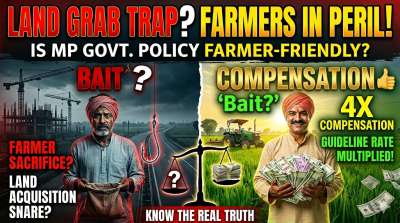
On April 22, 2026, the Madhya Pradesh Cabinet, chaired by Chief Minister Mohan Yadav, made a decision that the government is touting as “historic.” It was decided that when farmers’ land is acquired in rural areas, they will receive compensation up to four times the market rate. At first glance, this seems like a relief for farmers. However, when the layers of this decision are peeled back, several uncomfortable questions emerge.
What Happened Before, What Will Happen Now?
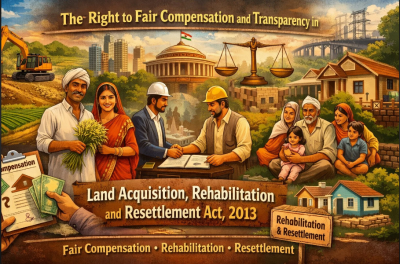
The new system came into effect on April 22, 2026. This decision has been implemented under the ‘Right to Fair Compensation and Transparency in Land Acquisition, Rehabilitation and Resettlement (Madhya Pradesh) Rules, 2015’.
In 2014, a Factor-1 was determined in the state. Under this, farmers began receiving double the guideline rate as compensation. The rate fixed in the Act was applied uniformly to both urban and rural areas.
What has changed now?
The multiplication factor for land acquisition in rural areas has been increased to 2.0, clearing the way for farmers to receive 4 times the compensation for their agricultural land compared to the market rate (guideline).
To put it simply: the government guideline value (circle rate) of the land was previously multiplied by 2; now it will be multiplied by 2 again—resulting in a 4-fold payout. But the catch here is the massive gap between the circle rate and the actual market price. Often, land with a market value of 10 lakh rupees per *bigha* has a circle rate of only 2-3 lakh rupees. In such cases, even a four-fold compensation remains lower than the real market value.
In urban areas, this factor will remain 1, as before. This means urban landowners will not get this benefit. The facility is provided only to rural farmers, but in reality, they are the section whose land is acquired the most.
Crucially, this benefit will also be applicable to all pending cases where a final award has not yet been passed. This is a positive aspect that will provide relief to old, aggrieved farmers.
The Real Background of This Decision
A ministerial committee submitted its report to the government after discussing it with more than 400 stakeholders, including farmer organizations, social institutions, CREDAI, and FICCI.
An interesting point to note here is: what were industry organizations like CREDAI (Confederation of Real Estate Developers’ Associations of India) and FICCI doing in a committee meant for “farmer welfare”? The question arises naturally.
Every year, an estimated 70,000–75,000 crore rupees are invested in the state for roads, bridges, railway lines, national highways, expressways, irrigation projects, and infrastructure development. The biggest hurdle to such massive investment was farmer opposition and pending compensation litigation. “Disputes over compensation are the biggest hurdle in land acquisition; by taking this decision, we have opened the path for development,” the Chief Minister himself stated. In other words, this decision is certainly a response to farmers’ demands, but it is also a strategy to ease the path of “development.”
In the same cabinet meeting, 25,164 crore rupees were approved for development works under the Public Works Department, and 7,212 crore rupees were sanctioned for the construction and operation of roads. So, the decision to facilitate land acquisition and the approval of thousands of crores for projects on that very land happened simultaneously.
Comparison with Other States
According to the central law—the *Right to Fair Compensation and Transparency in Land Acquisition, Rehabilitation and Resettlement Act, 2013 (RFCTLARR)*—compensation in rural areas was payable at 2 times the market value, and 1 time in urban areas. Based on this, the situation in different states varies:

Uttar Pradesh: Under the central law, rural areas get 2x compensation and urban areas get 1x. Disputes and legal battles over major projects like expressways are still ongoing.
Haryana: The central act is applied, but farmers frequently approach courts regarding the gap between circle rates and real market value.
Rajasthan: There have been repeated farmer agitations over land acquisition, but the compensation structure does not deviate from the central framework.
Maharashtra: Has created its own Maharashtra Land Acquisition Rules 2014 (Amendment 2023), under which the acquisition process is tailored to local conditions.

Madhya Pradesh has increased the multiplication factor from 1 to 2, effectively doubling the compensation from 2 times to 4 times. On paper, this move appears to put MP ahead of other major states. However, it is vital to remember that the gap between circle rates and market prices in MP is often much wider than in other states.
The Real Question No One is Asking
Now, for the question buried under this entire debate: Why is land being acquired at all? And why so much?
India’s Built-Up Area increased by 2.5 million hectares between 2005-06 and 2022-23—a 31% increase, a large part of which came from the conversion of agricultural land. Already, 2.8 crore hectares (8.7%) of land in India is in use for non-agricultural purposes, including urban development, roads, and industrial expansion.
In states like Haryana, Punjab, Maharashtra, Tamil Nadu, and Uttar Pradesh, large swathes of fertile agricultural land have been swallowed by urban sprawl. Studies confirm that in Uttar Pradesh, total sown area and other categories of agricultural land use are continuously declining. About 30% of India’s land—nearly 9.7 crore hectares—is already degraded. This area is equivalent to Northern Europe.
These statistics indicate that India’s model of development is on an unsustainable path.
A farmer’s land is for farming. It is for growing grain. It is the last line of defense for food security. And today, layers of cement, concrete, and tar are being laid over that very land.
The question is, who are these massive expressways, ring roads, and highway projects ultimately for? Behind every major road project is a construction lobby, a toll operator, and an automobile lobby whose goal is: the more roads built, the more vehicles sold; the more vehicles sold, the more petrol and diesel burned, and the more toll tax collected. And let us not forget the cement lobby behind housing construction.
This is not development. This is a planned cycle in the name of development where the farmer’s land is taken, some compensation is given, and then the farmer is forced to run a roadside *dhaba* (eatery) on that same highway.
Total land area is finite. Every hectare taken out of farming is lost to food production forever. This is a geographical truth that no government order can change.
The Madhya Pradesh government’s four-fold compensation decision is a step—perhaps a necessary one. But it is not a solution. A solution will only come when we decide that a farmer’s land is the last resort, not the first option.
We must prioritize using barren land and wastelands, reroute industries and roads, expand cities vertically rather than horizontally, and invest in railways and public transport so that the need for wide roads for every project is minimized.
Until that happens, every “historic” announcement of compensation is merely preparation to uproot a farmer’s life. Only at a slightly higher price.
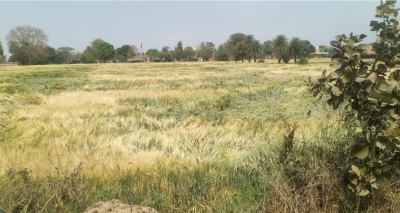
The destruction happening in the name of development cannot be measured by the amount of compensation. It can only be measured by the silence of the empty field where wheat once swayed, and where an expressway toll plaza now stands.
INDIAFIRST.ONLINE