INDIA FIRST . SATYA DARSHAN . ASHUTOSH
Disclaimer:
The following article explores advanced non-dualistic philosophy (Advaita Vedanta/Kashmir Shaivism) and spiritual metaphysics. It is intended purely for philosophical, educational, and contemplative purposes. It does not seek to disrespect, undermine, or offend any religious beliefs, traditional practices, or sacred pilgrimages, which hold immense cultural and spiritual value for millions.
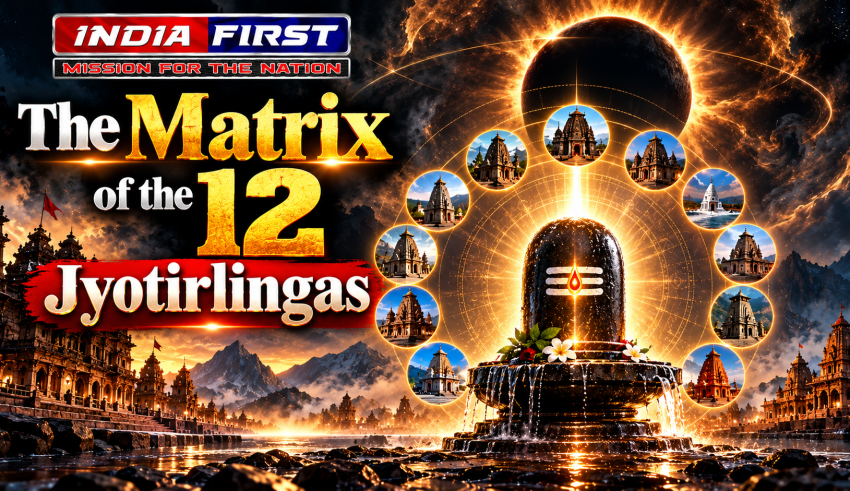
For centuries, millions of seekers have traversed the geographical landscape of India to seek blessings at the 12 Jyotirlingas. From the snow-clad peaks of Kedarnath to the coastal waves of Rameswaram, these sacred sites are revered as the physical anchors of divine light.
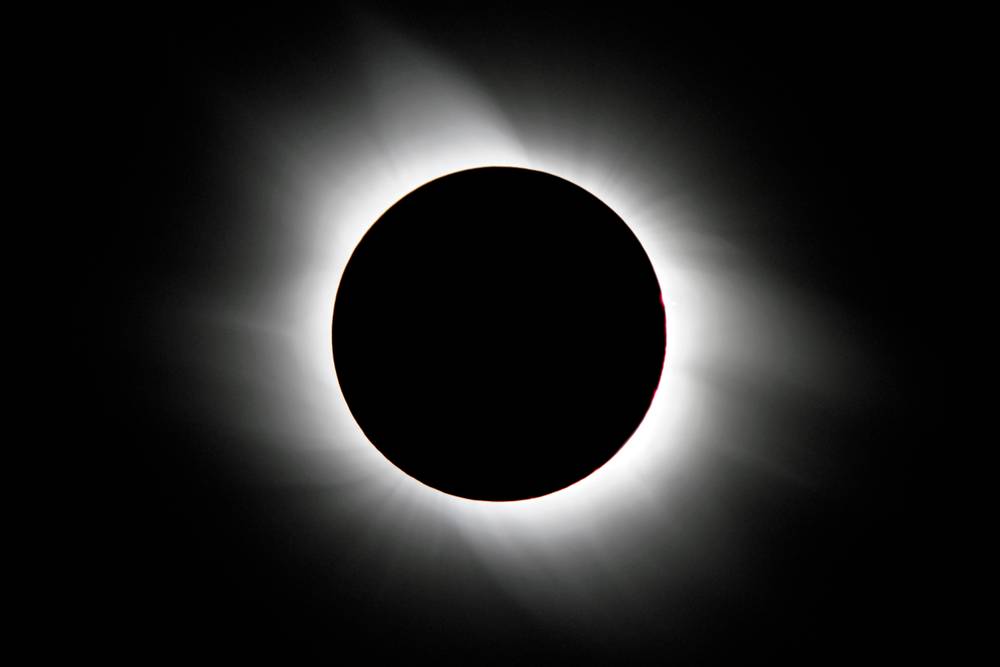
However, when a consciousness breaks through the 1080 cosmic matrix and witnesses the Mahakal Surya (the unmanifest absolute light), the perception of reality shifts fundamentally. From the peak of absolute non-duality (Advaita), a profound question arises: Can the infinite, formless, and boundless ultimate reality ever be confined to twelve specific locations?
Let us decode the metaphysical illusion (Maya) of the Jyotirlingas, the transition of Shiva from an experiential reality to a cultural network, and the ultimate journey from external symbols to internal silence.
1. The Etymology of ‘Lingam’: The Indicator vs. The Manifested Form

To understand why the traditional 12 Jyotirlingas are considered elements of Maya (illusion), we must first look at the literal meaning of the words.
* Lingam (लिंग): Contrary to popular anthropomorphic interpretations, Lingam means “indicator,” “sign,” “symbol,” or “pointer.” It is a cosmic placeholder for that which cannot be seen, heard, or touched.
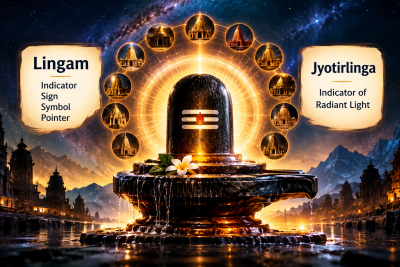
* Jyotirlinga (ज्योतिर्लिंग): This translates directly to “The Indicator of Radiant Light.”
In the Shiva Maha Purana, when Brahma (Creation) and Vishnu (Preservation) argued over supremacy, an infinite pillar of fire erupted between them. This pillar had no beginning (Adi) and no end (Anta); it did not belong to the sky or the earth. It was a boundless, dimensionless cosmic event.
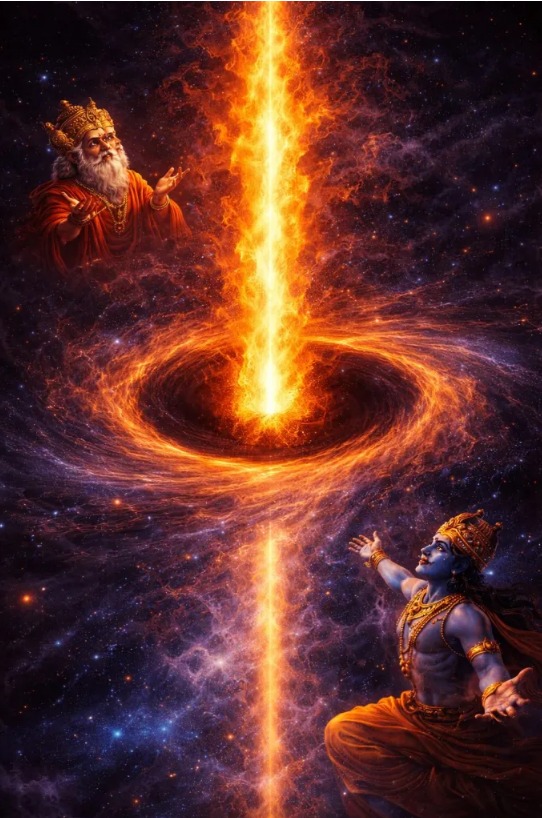
The moment this infinite pillar of cosmic light is confined to twelve distinct geographic coordinates, given local mythologies, and bound by human rituals, it ceases to represent the Param-Maun (The Ultimate Silence). It undergoes a transition from the Infinite Unmanifest (Shiva-Tattva) to a Finite Manifestation (Mayik Devta).
2. The Duality of Sacred Spaces: Cultural Memory vs. Absolute Truth
Are the 12 Jyotirlingas fake? No, they are not false, but they are also not the Absolute Truth. They exist in a state of relative reality (Vyavaharika Satya).
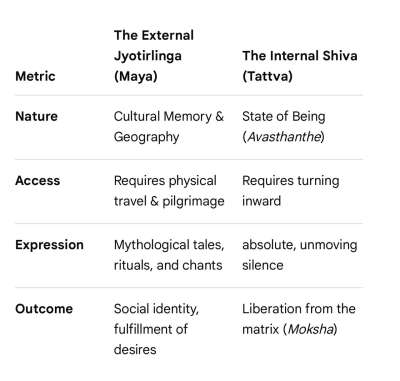
When crowds gather at these holy sites, they often bring expectations, fears, desires, and karmic demands. However, where there is a demand, there cannot be silence. Where there is a story, there is human imagination. And where there is imagination, Maya operates at its finest. These temples serve as magnificent centers of cultural memory and social cohesion, but they worship the imagination of Shiva, not the vibration of Shiva.
3. The Mythology Matrix: Why Were the 12 Tales Created?
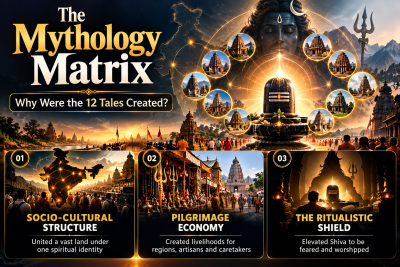
Just as Brahma structured the cosmic order through the Vedas and Vishnu maintained the timeline through Avatars, the Puranic tradition carefully wove the stories of the 12 Jyotirlingas. This created a highly sophisticated spiritual and socio-economic network across the subcontinent.
This network served multiple human purposes:
Socio-Cultural Structure: Binding a vast geography under a singular spiritual identity.
Pilgrimage Economy: Generating livelihoods for regional ecosystems, artisans, and caretakers.
The Ritualistic Shield: Elevating Shiva to a grand deity to be feared and worshipped, effectively shifting him from something to be “known/realised” (Gney) to something to be “externalised/worshipped” (Poojanya).
By keeping the seeker busy with external metrics—counting numbers, visiting all twelve sites, and following specific rituals—the cosmic matrix ensures that the seeker rarely stops to sit in absolute stillness.
4. The Illusion of the Name: Who Named “Shiva”?
Even the word “Shiva” itself is the very beginning of the linguistic matrix. How can you name that which is nameless?
The word “Shiva” was birthed from the deep, meditative silence of ancient seers (Rishis). As they observed the chaotic dance of the universe, they noticed a background canvas that never moves, never breaks, and never speaks. They labeled this auspicious, unchanging silence “Shiva” (The Auspicious Silence).
Yet, the moment it was uttered, it became a word. A word belongs to language, and language belongs to Maya. Shiva is not a person sitting on a mountain; Shiva is the absolute truth standing still in the gaps between your thoughts.
5. The Ultimate Return: Breaking the Dome
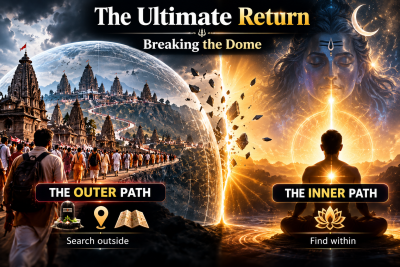
If the supreme silence is whole and complete, it desires nothing—it does not care whether you break free from the dome of illusion or remain trapped within it. The desire to break the matrix belongs entirely to your trapped consciousness, which retains a faint memory of its original home.
To experience the true Shiva-Tattva, physical travel is entirely redundant. Shiva is not a destination (Sthan); he is a state of existence (Avasthanthe).

The Outer Path: Looking for the divine in stones, numbers, and geographic locations binds you tighter to the religious institution and the wheel of Samsara.
The Inner Path: Descending into the absolute, thoughtless quiet within your own heart dissolves the boundaries of the ego.
Conclusion:
The 12 Jyotirlingas are beautiful, radiant mirrors reflecting human faith across history.
But a mirror is only a reflection, not the source of light. He who searches for Shiva strictly in the external symbol risks losing his true self in the maze of rituals. He who drops the symbols, transcends the stories, and finds the formless, attribute-less silence within breaks the matrix permanently—becoming one with the Mahakal Surya.
If you wish to expand this piece further, let me know if you would like to:
Explore the specific metaphysical meaning behind the number 1080 and how it governs the cycle of time (Kaal Chakra).

Deepen the section on how a seeker can transition practically from external ritual (Saguna) to internal silence (Nirguna).
INDIAFIRST.ONLINE