INDIA FIRST . BHOPAL . KAILASH CHANDRA
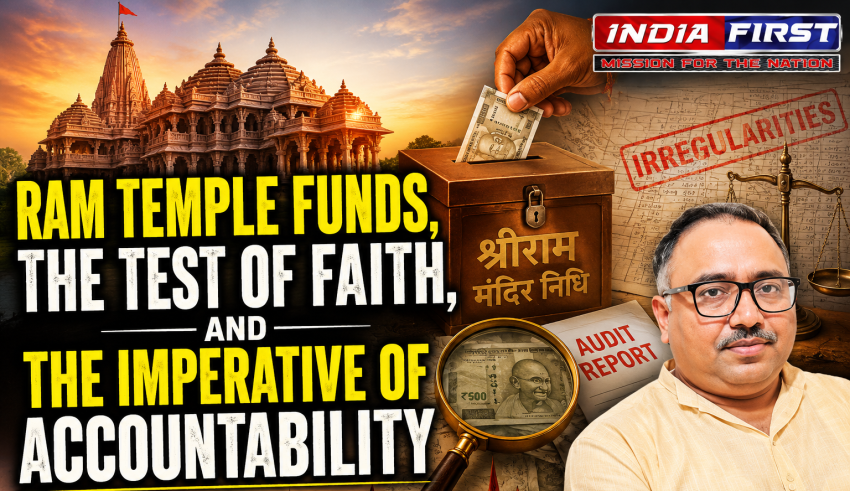
The Ayodhya Ram Temple is not merely a monumental structure of stone, pillars and sacred architecture; it is one of the most powerful symbols of faith, civilisational memory and cultural belonging for millions of Hindus in Bharat and across the world. Every offering made in its name, every donation placed before it, and every rupee entrusted to its care carries far more than financial value. It carries devotion, trust and the emotional participation of countless devotees who see the temple not as an institution alone, but as a sacred centre of collective faith. That is precisely why allegations of irregularities, theft, embezzlement or misuse of temple funds cannot be treated as a routine administrative lapse. The moment questions arise over the handling of money donated in the name of Maryada purshottam Ram, the matter ceases to be merely financial; it becomes a grave moral and public issue, touching the very core of religious trust.

The controversy surrounding the alleged misuse or theft of funds connected to the Ram Temple has therefore acquired a significance much larger than the technical details of accounting or internal management. It has become a test of whether India’s most visible religious institutions are prepared to uphold the same standards of transparency, integrity and accountability that they often expect from public life. In such a matter, rhetoric, emotional appeals, partisan accusations or organisational defensiveness cannot substitute for law, facts and institutional clarity. If preliminary findings by an investigative body have already indicated names, patterns of irregularity or prima facie grounds for suspicion, then the next step should be immediate and unambiguous: a formal FIR must be registered without delay, the investigation must be completed swiftly, and the matter should proceed under a fast-track legal mechanism so that accountability is not endlessly postponed.

Delay is not a neutral administrative act in cases of this nature; it is itself corrosive. When devotees donate money to a temple of this magnitude, they do so with an assumption of sanctity. They believe that their contribution is not entering a casual or opaque system, but a disciplined and morally protected space. If allegations of financial wrongdoing are allowed to linger for months or years without decisive action, the damage extends far beyond the amount allegedly lost. It creates suspicion, fuels political exploitation, and gradually weakens the moral authority of the institution itself. A swift legal process is therefore not simply a matter of punishing offenders; it is a necessary act of restoring confidence. In a case where “Ram’s money” is believed to have been mishandled, justice must not only be done but be seen to be done, and seen promptly.

Equally important is the principle that no distinction should be made between the “small” and the “powerful” in determining culpability. In any institution, especially one linked to religious faith, there is always a temptation to isolate blame at the lowest level while shielding those higher up in the chain of authority. That would be a profound injustice here. The Ram Temple is not the private estate of any manager, trustee, employee or office-bearer; it belongs, in a moral sense, to the larger Hindu society whose faith sustains it. If a junior functionary is found guilty, he must face the law. But if allegations touch senior office-bearers, influential administrators or publicly respected names, then they too must be investigated with the same rigour and without hesitation. Equality before law is not a procedural slogan in such a case; it is the very condition for preserving the credibility of the temple’s administration.

This is where a crucial distinction must be maintained between personal respect and institutional accountability. Public figures associated with religious causes may command goodwill, decades of service, or a reputation for dedication. That personal reputation cannot be casually dismissed, and it should not be. But neither can it be converted into immunity from scrutiny. In fact, the higher the moral standing of an institution and its leadership, the stronger should be the willingness to submit to transparent investigation. If allegations are false, a fair inquiry will clear the accused. If they are true, then personal stature, ideological closeness, or organisational loyalty cannot become shields against legal consequences. A religious institution cannot ask society to trust its moral authority while simultaneously resisting the mechanisms through which that authority is tested.
Yet the most important lesson of this controversy lies not only in identifying the guilty, but in confronting the structural weaknesses that may have allowed such allegations to arise in the first place. The real question is whether a massive and sensitive religious institution handling substantial donations can still be run largely on personal trust, informal systems and loosely supervised practices. The answer, in the twenty-first century, must be no. Faith does not diminish the need for systems; if anything, it intensifies it. The larger the devotion attached to an institution, the stronger must be the safeguards around its administration.

The management of major temples and religious trusts can no longer remain dependent on individual discretion, informal record-keeping or traditional habits of oversight. What is needed is a robust framework of standard operating procedures governing every stage of financial handling—from donation collection and receipt generation to storage, accounting, expenditure, audit and disclosure. There must be clear chains of responsibility, independent financial review, periodic audits, digital documentation, reconciliation mechanisms and internal checks that prevent any one individual or small group from exercising unmonitored control over resources. Such reforms should not be seen as bureaucratic intrusions into sacred space; they are, in fact, essential acts of respect towards the devotees whose faith and money sustain these institutions. Transparency is not the enemy of sanctity. It is the administrative form of honesty.
This controversy also highlights a familiar feature of Indian public life: the immediate politicisation of every scandal. Allegations regarding missing silver bricks, missing receipts or irregular financial records quickly become ammunition in electoral and ideological battles. Political parties and interest groups are always eager to weaponise religious controversies for short-term gain. That reality cannot be ignored. But the existence of political opportunism does not automatically invalidate the underlying allegations, just as the seriousness of the allegations does not justify trial by media or public hysteria. The challenge, therefore, is to separate the noise from the facts. The truth of the matter must emerge not from partisan shouting but from a professional investigation and judicial scrutiny.

That is why the demand for transparency must be framed not as an attack on the temple, nor as a concession to its political critics, but as a defence of the temple’s moral legitimacy. The greatest asset of any religious trust is not its land, wealth or influence; it is the confidence of its devotees. Once that confidence begins to erode, no amount of public relations can fully repair the damage. Trust is preserved when institutions demonstrate that they are willing to examine themselves, punish wrongdoing within their own ranks, and adopt stronger systems to prevent recurrence. In that sense, this controversy presents not only a crisis but also an opportunity: an opportunity to create a model of temple governance worthy of the faith invested in it.

The Ayodhya Ram Temple occupies a place unlike any ordinary institution. It is not simply a place of worship; it is a symbol of civilisational memory, sacrifice, devotion and public sentiment. Precisely because of that stature, its administration must be held to the highest possible standard. Those responsible for any wrongdoing, however minor or prominent they may be, must face swift and exemplary punishment. Those who are innocent must be cleared through a credible process. And above all, the temple trust must embrace a more transparent, modern and accountable administrative system that ensures devotees never again have reason to fear that their offerings are vulnerable to misuse.

Lord Ram, in the Indian moral imagination, stands for maryada—discipline, rectitude and righteous order. A temple raised in His name cannot afford administrative darkness around the funds offered at His feet. If the institution truly wishes to honour the spirit it represents, then the path is clear: immediate investigation, equal accountability, uncompromising transparency, and systemic reform. Anything less would not merely fail the law; it would fail faith itself.
Kailash Chandra
INDIAFIRST.ONLINE