
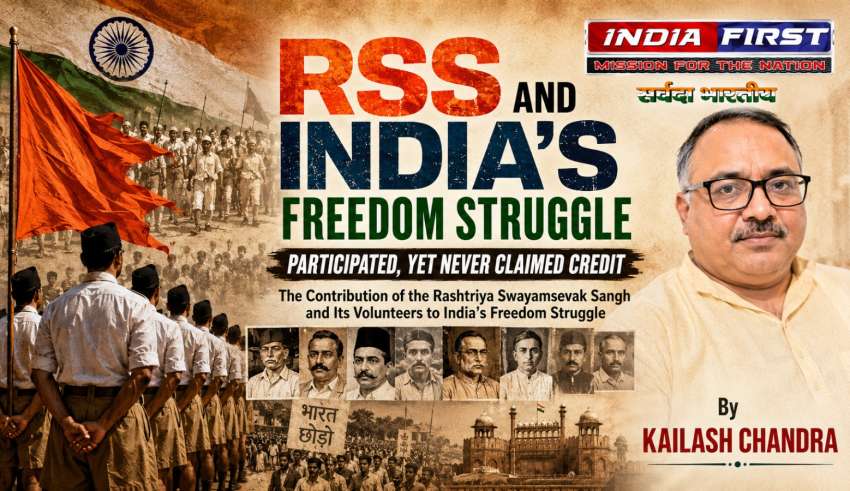
INDIA FIRST . BHOPAL . KAILASH CHANDRA
The history of India’s freedom movement is vast, complex, and multidimensional. It encompasses numerous organizations, ideologies, revolutionaries, social reformers, and millions of ordinary citizens who contributed to the nation’s liberation. Among them were several individuals and organizations whose contributions were significant, yet who neither sought publicity nor claimed exclusive credit for their efforts. The phrase “Participated, Yet Never Claimed Credit” aptly captures an important aspect of the working culture and ethos of the Rashtriya Swayamsevak Sangh (RSS) and its volunteers.
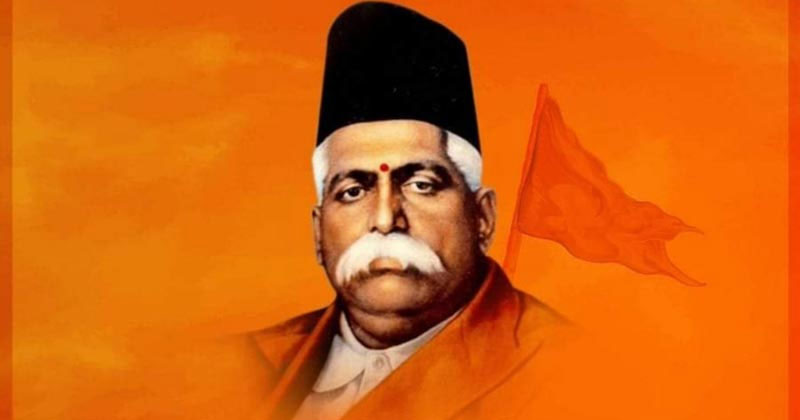
Founded in 1925 by Dr. Keshav Baliram Hedgewar, the RSS emerged during a period of intense national awakening. Dr. Hedgewar himself was an active participant in India’s freedom movement. He was sentenced twice to one year of rigorous imprisonment by the British authorities for his involvement in anti-colonial movements. The first imprisonment came during the Non-Cooperation Movement, while the second followed his participation in the Jungle Satyagraha during the Civil Disobedience Movement. Significantly, nearly 150 RSS volunteers also took part in the Jungle Satyagraha, demonstrating that the organization’s connection with the freedom struggle was not merely ideological but also practical and participatory.

Throughout different phases of the independence movement, numerous RSS volunteers were individually involved in nationalist activities. During the Quit India Movement of 1942, many swayamsevaks and pracharaks participated in various capacities, including organizational support, public mobilization, communication networks, and underground activities. Although the RSS was still a relatively young organization at the time, its volunteers placed national interest above all else and contributed wherever they could.
Several RSS workers and pracharaks played notable roles during the freedom struggle. Among them was Jaydevji Pathak of Rajasthan, who later became active in the Vidya Bharati movement. In Arvi, Vidarbha, Dr. Annasaheb Deshpande contributed significantly to nationalist awakening. In Jashpur, present-day Chhattisgarh, Ramakant Keshav (Balasaheb) Deshpande worked extensively for social organization and national consciousness. He later founded the Vanvasi Kalyan Ashram, which became a major institution dedicated to the welfare and development of tribal communities.
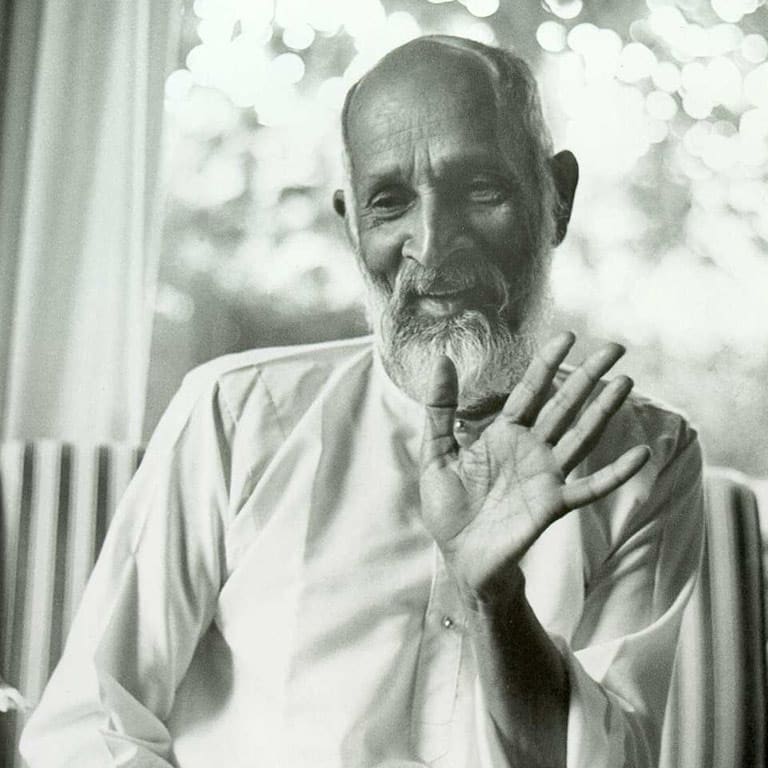
In Delhi, Vasantrao Oak played an important role during the nationalist period and later became the Prant Pracharak of Delhi. In Bihar, the renowned advocate Krishna Vallabh Prasad Narayan Singh, affectionately known as “Babuaji,” was associated with nationalist activities and later served as the Sanghchalak of Bihar. Another prominent figure was Chandrakant Bhardwaj of Delhi, who was injured during the freedom struggle when a bullet became lodged in his leg and could never be removed. He later emerged as a respected poet and composed many inspirational songs associated with the RSS.
In Eastern Uttar Pradesh, Madhavrao Devde worked tirelessly to spread national consciousness and later became a provincial-level organizer. Similarly, Dattatreya Gangadhar (Bhaiyaji) Kasture of Ujjain made noteworthy contributions to the nationalist cause. What united these individuals was their commitment to placing national service above personal fame and recognition.
Several other personalities associated with the RSS tradition also deserve mention in discussions on the freedom movement. These include Daivipanth Chaudhary, Jagatpati Kumar, Annasaheb Deshpande, Ramakant Keshav Deshpande, Vasantrao Oak, Narayan Singh, Mukund Huddar, Chandrakant Bhardwaj, Dadanayak Chimur, Baburao Begde, Lala Hansraj, and Balaji Raipurkar. Many among them endured imprisonment, some carried out organizational responsibilities, while others directly participated in nationalist activities that strengthened the spirit of resistance against colonial rule.
The sacrifice of Hemu Kalani stands out as a shining example of youthful courage and patriotism. This young revolutionary from Sindh laid down his life while resisting British rule. Similarly, the martyrdom of Rajabhau Mahakal remains an inspiring example of devotion to the nation. Their sacrifices remind us that India’s independence was not merely a political achievement but the culmination of countless acts of courage and selflessness.
Even after India attained independence in 1947, the process of national integration remained incomplete. Goa, Daman, and Diu continued under Portuguese rule. Numerous volunteers participated in the movements aimed at liberating these territories. Figures such as Master Govind and Mohan Ranade played active roles in the Goa Liberation Movement. Their efforts demonstrated that the idea of national freedom extended beyond political independence and included the complete territorial and cultural integration of the nation.
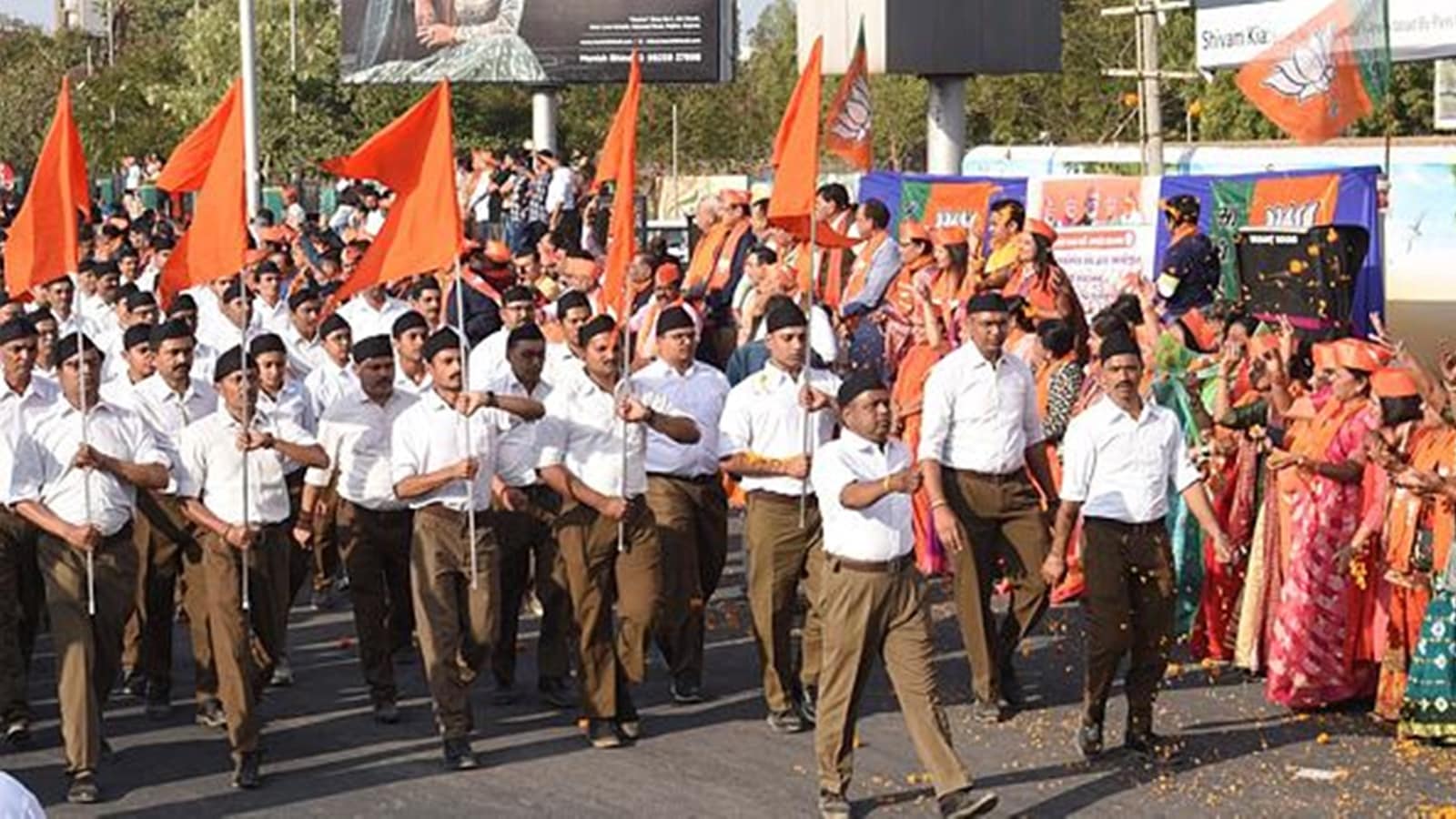
One of the defining features of the RSS has been its emphasis on service without expectation of recognition. The organization sought to cultivate in its volunteers a spirit of dedication to society and the nation rather than personal ambition. RSS workers contributed in various fields of national life, yet many refrained from publicizing their efforts. Their belief was simple: if society became organized, awakened, and self-confident, the nation would naturally become strong.
This explains why the RSS tradition has often placed duty above acclaim and service above publicity. The emphasis has remained on strengthening society rather than promoting individual achievements.
In an age increasingly shaped by image-building, media visibility, and the pursuit of instant recognition, the principle of “Participated, Yet Never Claimed Credit” acquires renewed relevance. It reminds us that nation-building is not the responsibility of a single individual or organization but a collective endeavor involving society as a whole. Those who inspire, organize, and empower society while remaining in the background often become the architects of lasting change.
A comprehensive understanding of India’s freedom struggle requires acknowledging all dimensions of that historic movement. The story of independence is not only the story of well-known national leaders; it is also the story of thousands of known and unknown patriots who dedicated their lives to the cause of freedom. The contribution of the RSS and its volunteers should be viewed within this broader context.
Their central message was clear: the nation comes first, society is the true source of strength, and the highest form of service is participation without expectation of recognition.

“Participated, Yet Never Claimed Credit” is therefore more than a phrase. It is an enduring ideal of humility, dedication, organization, and duty. It reflects a tradition of selfless service that inspired many volunteers during the freedom struggle and continues to offer guidance for nation-building in contemporary India.
— Kailash Chandra
INDIAFIRST.ONLINE