INDIA FIRST . SATYA DARSHAN . ASHUTOSH
Legal Disclaimer:
This article is based on an analysis of historical documents, published research papers (such as the Flexner Report of 1910 and the ICMR Report of 2019), and publicly available news reports. Its objective is not to tarnish the reputation of any specific institution or individual, but rather to foster public awareness regarding the historical evolution and current challenges facing medical education. The views expressed herein are grounded in the historical findings of researchers and experts. Readers are advised to consult with a qualified professional before making any medical decisions.
— Public First | Special Research Article
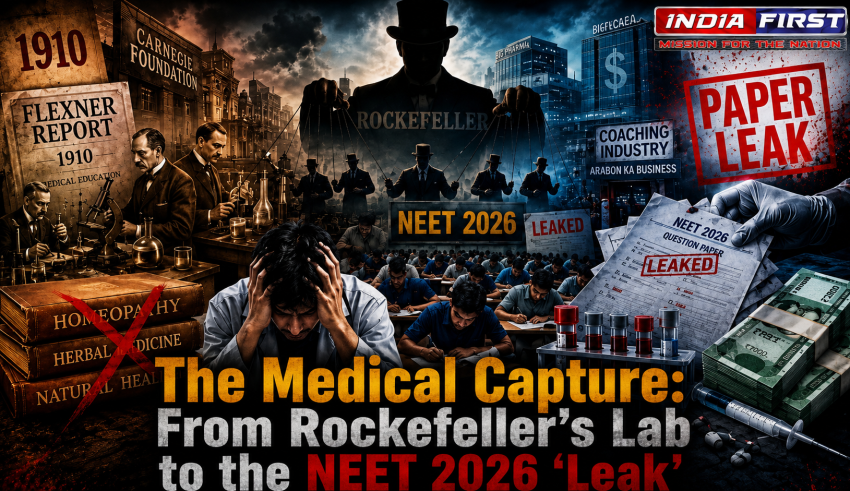
Today, as we discuss the issue of paper leaks in 2026, we must recognize that this is no mere coincidence; rather, it is a meticulously orchestrated business blueprint spanning 150 years. It marks a dark journey—one that transforms ‘service’ into ‘data’ and the ‘healer’ into a ‘pharma agent.’
Section 1: The Battle for Supremacy (1847–1900)
The Golden Age of Natural Medicine vs. The Rise of Pharma
1847: Establishment of the American Medical Association (AMA).
This was the first blueprint for the ‘capture’ of the system. It was mandatory for pharmaceutical companies to advertise in the AMA’s journal; only those whose advertisements were published were designated as “Approved” doctors.
1872–1900:
Natural medicine was at its zenith in America. By 1900, there were 22 homeopathic and 15 herbal (Eclectic) medical schools in the United States.
Treatments such as homeopathy, osteopathy, and hydrotherapy were highly popular because their results were effective.
The Threat:
This surging popularity posed an existential crisis for the nascent ‘petrochemical-based’ pharmaceutical industry.
Part 2: The Blueprint for Capture (1897–1910)
Rockefeller’s Investment and Flexner’s ‘Assault’
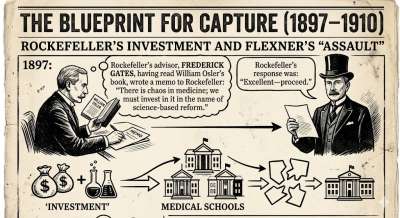
1897:
Rockefeller’s advisor, Frederick Gates, having read William Osler’s book, wrote a memo to Rockefeller: “There is chaos in medicine; we must invest in it in the name of science-based reform.” Rockefeller’s response was: “Excellent—proceed.”
1910: The Flexner Report (The Kill Shot):
Rockefeller and Carnegie appointed Abraham Flexner (who was not a doctor himself). Flexner visited 155 schools in just seven weeks and produced a report that transformed medical practice across the entire world.
The Result:
Over the next 25 years, only 31 of the 155 schools survived. Homeopathic and herbal schools were completely eliminated. This was not achieved through legal bans, but rather through “financial strangulation.”
The Years of Control (1913–1945)
The “Global” Alliance of Money and Medicine
1913 (Federal Reserve Act):
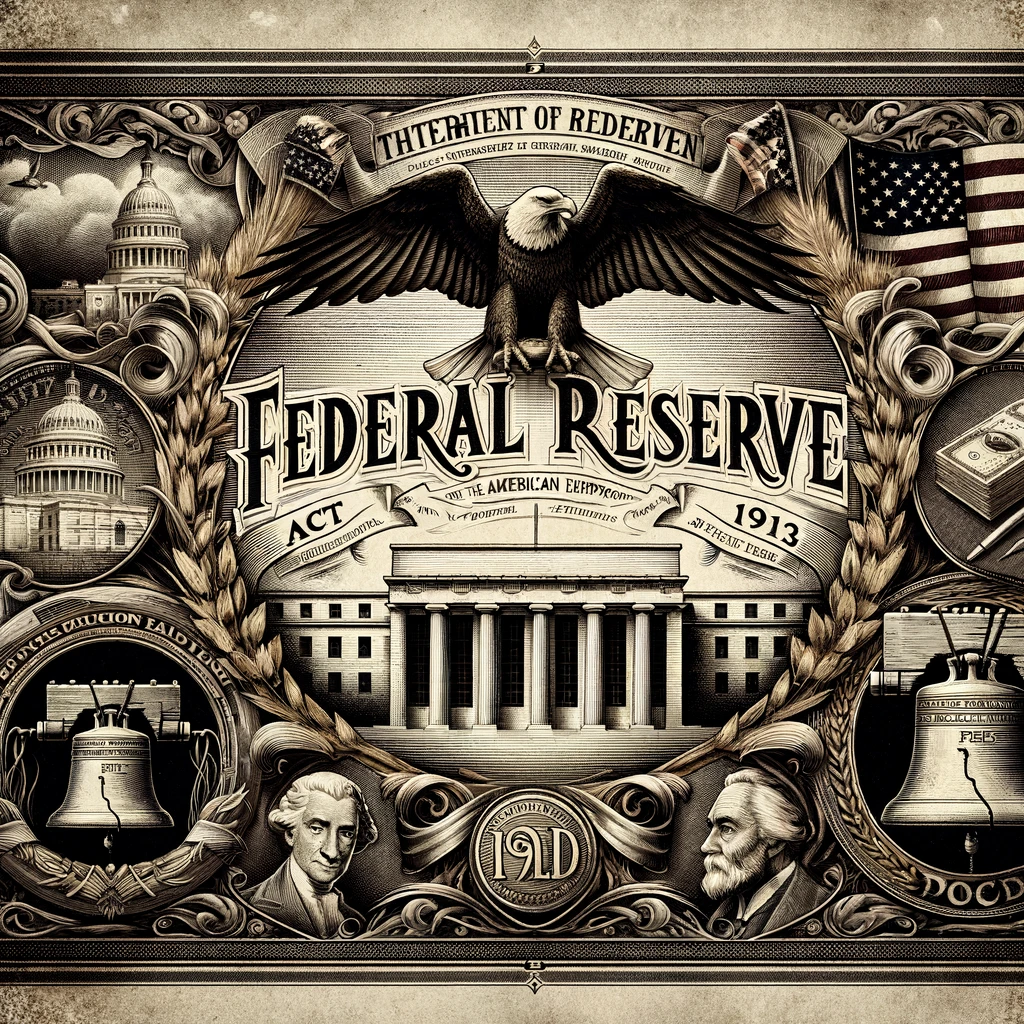
Woodrow Wilson signed it on January 16, 1913. Representatives of Rockefeller and J.P. Morgan took control of the US monetary system.
1913 (Rockefeller Foundation):
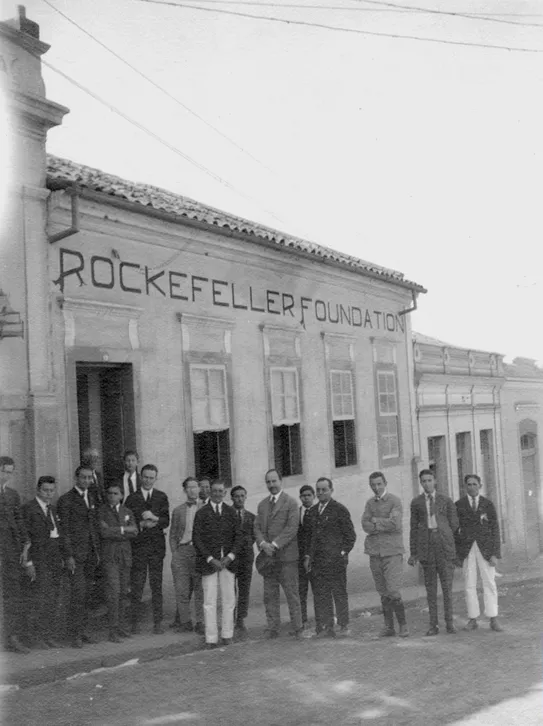
That same year, this foundation was established in the name of ‘philanthropy.’ Its true agenda was to control medical research and education worldwide.
A Two-Pronged Trap:
They now held control over both the money supply and the medical system.
1920s–1940s:
The era of antibiotics began. Although they saved many lives, they fostered a blind faith in the ‘Germ Theory,’ thereby rendering traditional concepts—such as ‘immunity’ and ‘nature’—secondary.
The Commercialization of the System (1950–2010)
The Reign of Statistics Over Compassion
1970s:
The rise of the ‘insurance’ and ‘corporate hospital’ models. ‘Managed care’ and ‘third parties’ now interposed themselves between the doctor and the patient.
1980s–1990s:
Medical education fees skyrocketed.
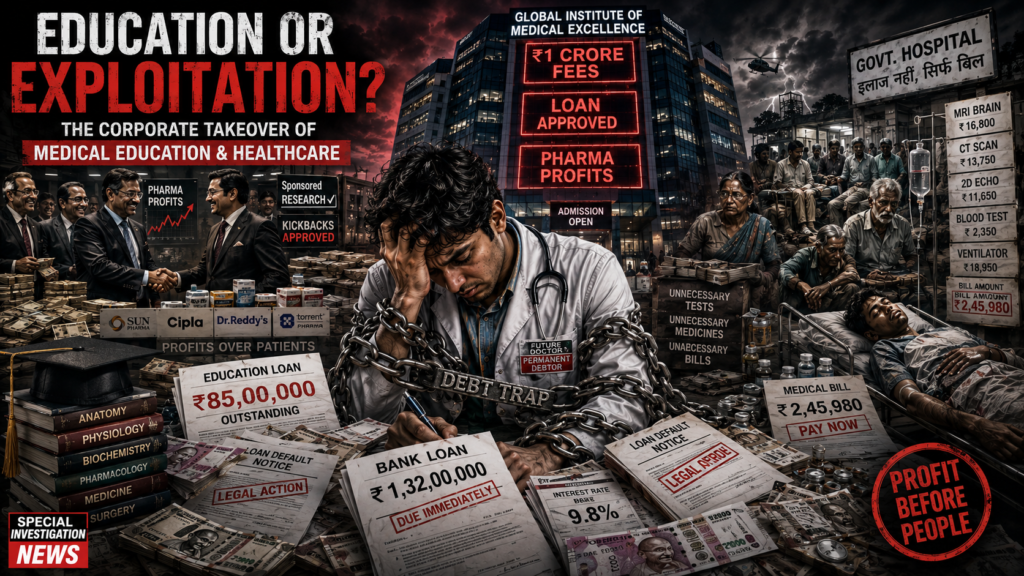
Doctors were compelled to pursue their studies by taking out massive loans, a situation that shifted their primary focus from “patient welfare” to “debt repayment” and “pharmaceutical commissions.” The root cause of the exorbitant surge in medical education fees between 1980 and 1990 lay in the “corporatization” of medical education and a reduction in government subsidies. During this decade, under the “Rockefeller Model,” medicine was firmly established as a “profit-generating industry,” a transformation that artificially inflated the operational costs of running medical colleges. As governments curtailed public health budgets, private investment surged; consequently, institutions began imposing the burden of exorbitant fees upon students in order to recoup these investments. This marked the inception of the “debt trap”—a vicious cycle wherein students began qualifying as doctors by incurring debts amounting to tens of millions, making it an economic imperative for them to pressure patients into undergoing unnecessary diagnostic tests and consuming superfluous medications in order to repay those loans.
Reference (Source):
Marcia Angell — The Truth About Drug Companies, Random House, 2004
2004–2010:
Manipulating the Parameters. The standard thresholds for cholesterol and blood sugar levels were lowered, thereby transforming millions of healthy individuals into “patients” overnight.
The “Mechanization” of Education and a Multi-Billion Dollar Market (1990–2026)
1990s: Medical education fees witnessed a massive surge. Education ceased to be an act of “philanthropy” and evolved into a mere “investment.”
2012–2019: There was an inundation of unnecessary pathology laboratory tests. Studies revealed that such tests accounted for $200 billion in the U.S. and constituted 40% of all tests conducted in India.
The NEET Paper Leak and the Zenith of Apathy

2013–2020:
Medical education in India was completely ‘centralized.’ Through examinations like NEET, the admission process was transformed into a ‘marketplace.’
2023–2025:
The medical coaching industry grew into a multi-billion-dollar enterprise. Education became confined solely to ‘rote learning’ and ‘data.’ Compassion and the spirit of service vanished.
2026:
The NEET Paper Leak Crisis: This marks the nadir of this decline. When the very foundation of medical education rests upon corruption and multi-crore bidding, how can the doctors emerging from such a system ever truly comprehend the value of a ‘human life’?
Examinations like NEET were completely centralized, thereby creating a ‘Single Point of Failure’—a focal point for corruption.
The NEET Paper Leak and the Economics of ‘Multi-Crore Seats’

To understand why examinations like NEET are being leaked repeatedly these days, one must grasp the economics of ‘Return on Investment’ (ROI). When the price of a seat in a private medical college soars to between ₹1 crore and ₹1.5 crore, securing a seat based on ‘merit’ becomes a matter of life and death for the middle class. This is precisely where the ‘paper leak industry’ is born. It has now evolved into an organized syndicate worth billions of rupees. If a single exam paper sells for anywhere between ₹25 lakh and ₹50 lakh, and is purchased by even just 1,000 students, it instantly transforms into an illicit trade worth ₹5,000 crore.
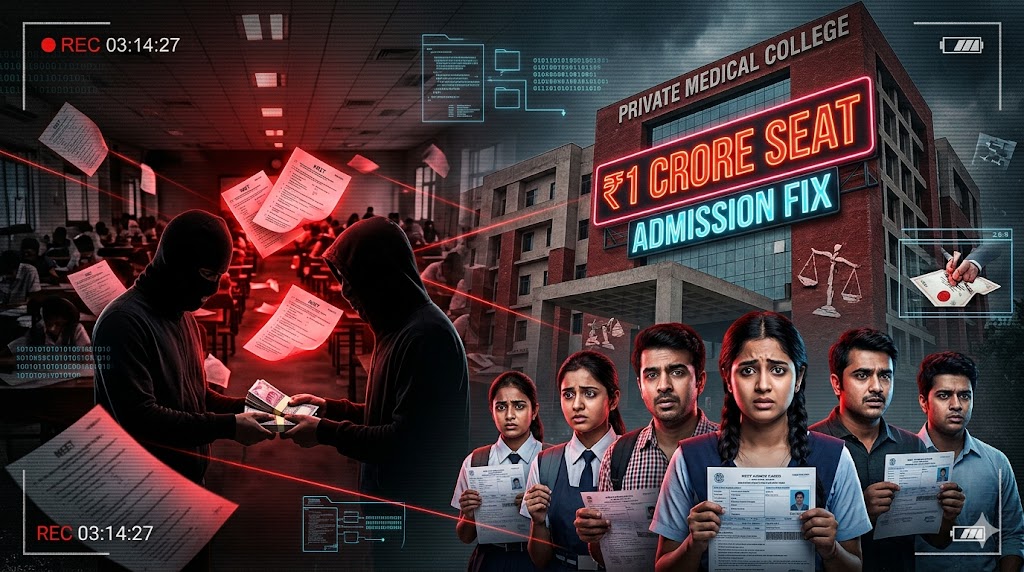
The ‘mechanical system’ initiated by Rockefeller has severed the doctor’s connection to ‘compassion,’ linking him instead to ‘profit.’ Today’s student seeks entry into this system not out of a desire to become a doctor, but rather to recoup the ‘capital’—the investment—he poured into purchasing his seat. This is precisely why the threads of paper-leaking syndicates often lead back to individuals entrenched within that very ‘system’—the very people who control this entire medical supply chain.
A Slave to the System:
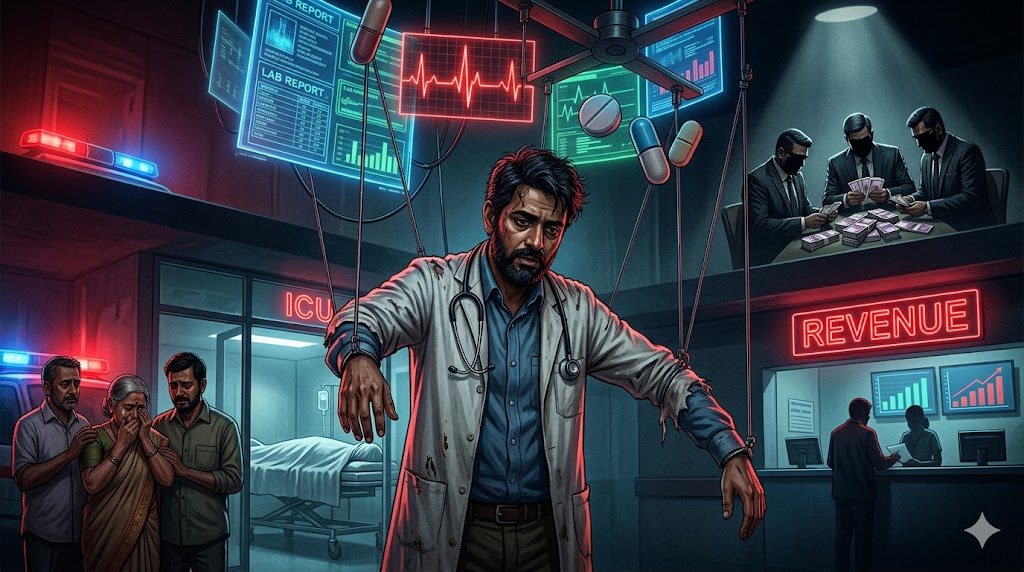
The modern-day doctor is increasingly becoming a slave to the system. Rather than relying on his own intellect, he operates in a robotic fashion, guided solely by lab reports and pharmaceutical protocols. This explains why, today, even a deceased body is held hostage; for the entire establishment now focuses not on the ‘human being,’ but on ‘revenue.’
Conclusion: Is There a Way Out?
This entire ‘ecosystem’ has been designed to foster dependency. Beyond the profits derived from pharmaceuticals, their primary objective is to keep us enslaved to the ‘system.’ Until we break free from the ‘chemical and lab’ model imposed by Rockefeller and re-embrace the scientific principles of Ayurveda and a natural lifestyle, we will remain trapped within this ‘grid.’
— INDIA FIRST | Truth. Freedom. Self-Respect.
References (Sources):
Ron Chernow — Titan: The Life of John D. Rockefeller, 1998.
Abraham Flexner — Medical Education in the United States and Canada, 1910.
Paul Starr — Social Transformation of American Medicine, 1982.
BMJ — Conflict of Interest in Guidelines, 2013.
Marcia Angell — The Truth About Drug Companies, 2004.
ICMR — Rational Use of Diagnostics, 2019.
ABIM Foundation — Choosing Wisely, 2012.
ICMR — Rational Use of Diagnostics, 2019.
Abraham Flexner — Medical Education Report, Carnegie Foundation, 1910.
Ron Chernow — Titan, 1998.
Thomas McKeown — The Role of Medicine, Princeton, 1979.
INDIAFIRST.ONLINE