INDIA FIRST . SATYA DARSHAN . ASHUTOSH
HIGHLIGHTS FIRST:
The Truth of Scarcity: The Grand Conspiracy of Artificial Shortages in Water, Grain, and Oil — Documented
Nature possesses everything—yet the world is yearning. Why?
Introduction — A Question That Changes Everything
On Earth—
• Enough grain is grown to feed 10 billion people—yet 800 million remain hungry.
• Water covers 70% of the Earth—yet 2 billion people lack access to clean water.
• The Sun transmits enough energy every hour to meet the entire world’s needs for a year—yet an energy crisis persists.
• Oil reserves have been “on the verge of depletion” for 150 years—yet they have not run out.
This is no coincidence.
This is the secret of Scarcity—a secret that every citizen must understand.
Part One — What is Scarcity? The Two Types
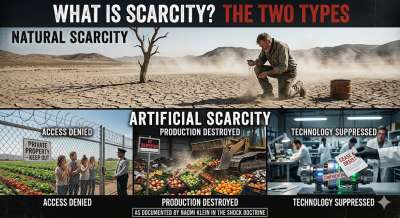
Natural Scarcity
Droughts, floods, earthquakes—these are real. There is no conspiracy involved here.
Artificial Scarcity
Resources exist—yet access is denied.
Production exists—yet it is destroyed.
Technology exists—yet it is suppressed.
Naomi Klein documented this in *The Shock Doctrine*:
Create a crisis—instill fear in the people—then impose your own solution.
This very formula works in every instance of scarcity.
Part Two — The Secret Behind Grain Scarcity
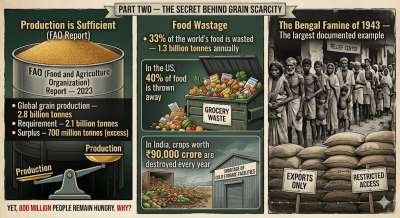
Fact 1 — Production is Sufficient
FAO (Food and Agriculture Organization) Report —
• Global grain production in 2023 — 2.8 billion tonnes
• Requirement — 2.1 billion tonnes
• Surplus — 700 million tonnes (excess)
Yet, 800 million people remain hungry. Why?
Fact 2 — Food Wastage
• 33% of the world’s food is wasted — 1.3 billion tonnes annually
• In the US, 40% of food is thrown away
• In India, crops worth ₹90,000 crore are destroyed every year due to a shortage of cold storage facilities
Fact 3 — The Bengal Famine of 1943 — The largest documented example
3–4 million Indians died.
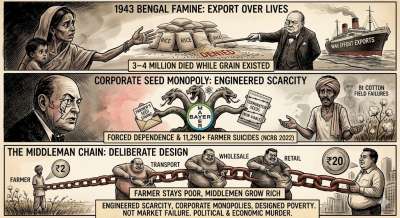
However, Madhusree Mukerjee documented in *Churchill’s Secret War* that:
• There was grain available in Bengal.
• The Churchill government continued exporting it for the war effort.
• Indians were denied access to food.
• Churchill remarked, “Indians breed like rabbits; that is why famines occur.”
This was not a case of natural scarcity—it was political murder.
Fact 4 — Corporate Seed Monopoly
• Previously, farmers would save their own seeds—year after year.
• Monsanto/Bayer developed “Terminator Seeds”—seeds that do not yield a subsequent generation.
• Farmers are thus compelled to purchase seeds every single year.
• Bt Cotton in India has been a documented failure.
• NCRB Data (2022): 11,290 suicides among farmers and agricultural laborers.
The scarcity of seeds was not created by nature, but by corporations.
Fact 5 — The Middleman Chain
• The farmer receives ₹2.
• The consumer pays ₹20.
• In between lies a chain of middlemen.
• The farmer remains poor, while the middlemen grow rich.
This is not a market failure—it is a deliberately designed system.
Part Three — The Mystery of Water Scarcity
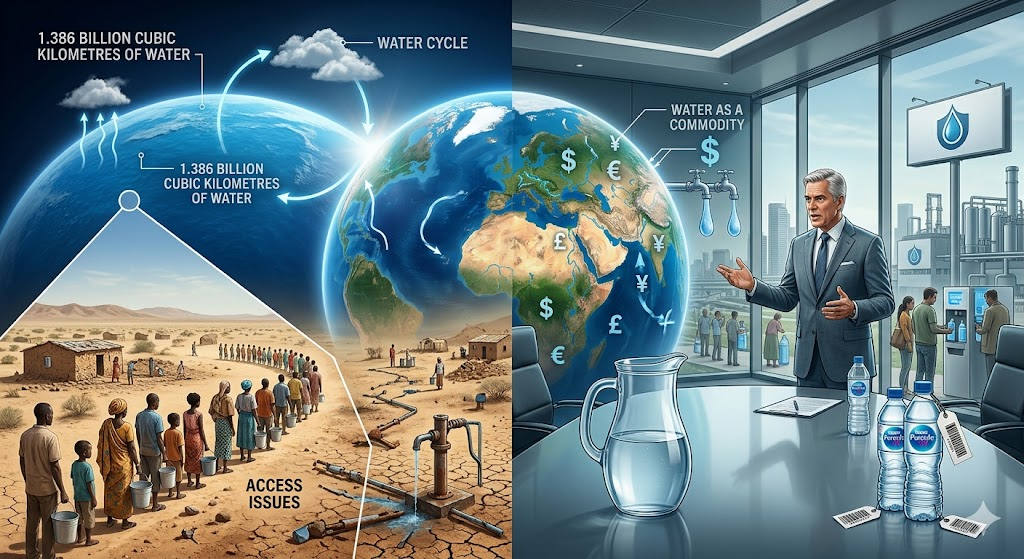
Fact 1 — There is no shortage of water
• There are 1.386 billion cubic kilometers of water on Earth.
• The Water Cycle — Water never runs out; it merely changes form.
• The shortage lies in — access and distribution.
Fact 2 — Nestlé and the Privatization of Water
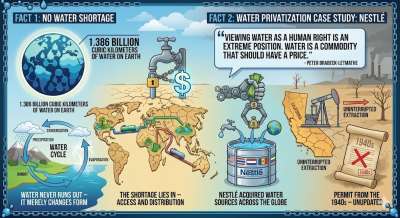
Nestlé’s former CEO, Peter Brabeck-Letmathe, stated in a documentary:
“Viewing water as a human right is an extreme position. Water is a commodity that should have a price.”
Subsequently:
• Nestlé acquired water sources across the globe.
• Nestlé continued to extract water in California, even during periods of drought.
• Their permit dated back to the 1940s — and remained unupdated.
The water was there — but it was privately owned.
Fact 3 — The Cochabamba Water War (2000) — Bolivia

• The World Bank granted a loan to Bolivia.
• The condition: Privatize the water supply.
• Control of the water system was handed over to the Bechtel Corporation (USA).
• Prices skyrocketed by 300% — leaving the poor unable to afford it.
• The public rose in rebellion — and the government was forced to yield.
• Bechtel was expelled.
This is a well-documented event — and this very blueprint is being applied everywhere.
Fact 4 — The Groundwater Crisis in India
• In Punjab and Haryana, following the Green Revolution:
• The cultivation of paddy (rice) was introduced — a crop that was not native to the region.
• This required excessive amounts of water.
• Groundwater levels are currently dropping by 1 meter every year.
• A NITI Aayog report projects that groundwater reserves in 21 major cities could be completely depleted by 2030.
This crisis was manufactured through policy decisions.
Solutions — What Works
• Rajasthan’s *Johad* system — a traditional method of water harvesting.
• Anna Hazare’s Ralegan Siddhi model — a village transformed through effective watershed management.
• Rainwater harvesting — made mandatory in Chennai, yielding tangible results.
A cure for water scarcity exists — what is lacking is the political will to implement it.
Part Four — The Greatest Secret of Oil and Energy
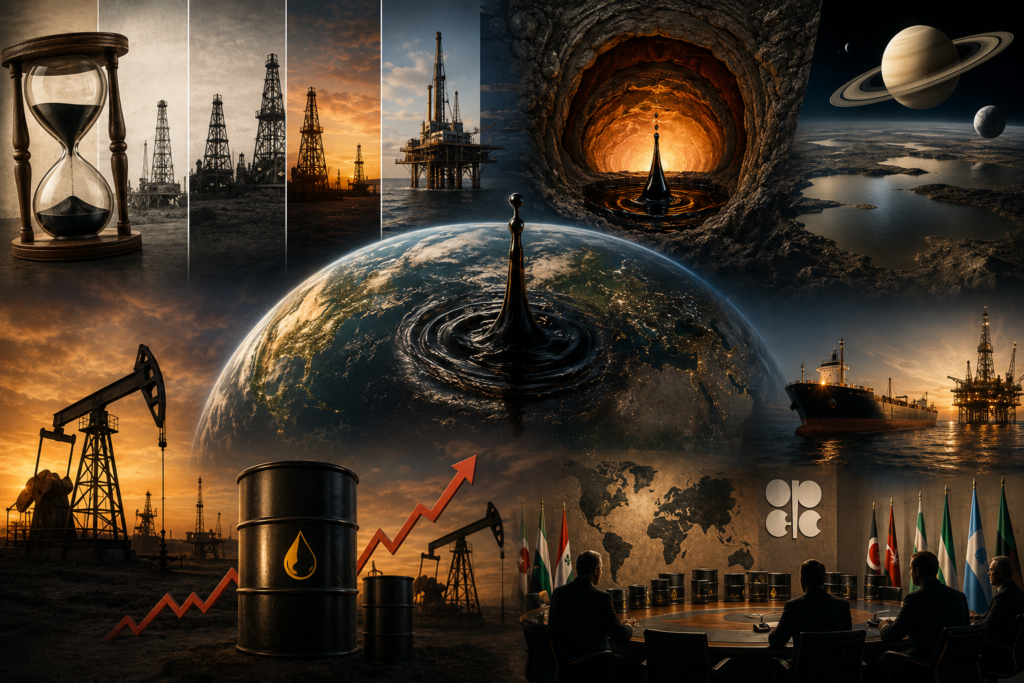
Fact 1 — “Oil is running out” — How long has this been said?
• 1919 — US Bureau of Mines — “Oil will run out in 10 years”
• 1943 — US State Department — “Oil will run out in 5 years”
• 1973 — Oil Crisis — “Peak Oil has arrived”
• 1979 — Carter administration — “Oil is running out”
• 2005 — Peak Oil theory again — “Now it really will run out”
• 2023 — BP and Shell hold record reserves
The oil that has been “running out” for 100 years — has not run out.
Fact 2 — Abiogenic Oil Theory — The most controversial, yet significant
The concept of Fossil Fuels:
We are taught — oil is formed from dead organisms — over millions of years.
But there is an alternative theory:
The Abiogenic Petroleum Origin Theory —
• Proposed by Russian and Ukrainian scientists in the 1950s
• Prominent among them were — Nikolai Kudryavtsev and Vladimir Porfir’yev
• This theory states — oil is formed deep within the Earth through abiotic (non-biological) processes
• It is continuously being generated
What is the evidence?
• Eugene Island — An oil field in the Gulf of Mexico that went “dry” in the 1970s. It refilled in the 1990s.
• Some wells that had gone “dry” — began producing oil once again
• There are hydrocarbon lakes on Saturn’s moon, Titan — yet there were no dinosaurs there
Why isn’t this theory part of the mainstream?
If oil is renewable —
Then the narrative of scarcity collapses.
Then price controls become obsolete.
Then the justification for an “energy crisis” vanishes.
Note: This theory has not yet been fully proven. However, it deserves to be taken seriously.
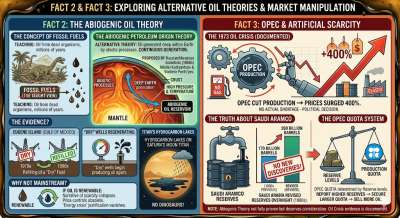
Fact 3 — OPEC and Artificial Scarcity
The 1973 Oil Crisis — Documented:
• OPEC cut production.
• Prices surged by 400%.
• The global economy was shaken to its core.
• There was no actual shortage of oil — the reduction in supply was a political decision.
The Truth About Saudi Aramco:
• In the 1980s, Saudi Arabia revised its estimate of its oil reserves — overnight.
• Proven reserves jumped from 170 billion barrels to 260 billion barrels.
• No new discoveries had been made.
• The OPEC quota system is determined based on reserve levels.
• Report higher reserves — secure a larger quota — sell more oil.
Fact 4 — How Oil Companies Suppressed Solar Energy
This is the most important documented fact:
ExxonMobil’s Internal Research (1977):
Result:
• Solar and wind energy were prevented from becoming mainstream for decades.
• Subsidies — granted to oil, denied to solar.
• IMF Report (2023) — Fossil fuels receive a global subsidy amounting to $7 trillion per year.
Fact 5 — The Mystery Behind the Current Oil Crisis of 2026
The Iran Conflict and the Strait of Hormuz:
As we observed earlier:
• 70% of India’s crude oil now originates from outside the Hormuz region.
• 90% of India’s LPG imports pass through Hormuz — this constitutes a genuine concern.
• However, there is no actual shortage of crude oil.
So, why have prices risen?
Trading and Speculation:
• Traders in the oil futures market engaged in panic buying.
• Goldman Sachs, JP Morgan — these banks actively trade in oil futures.
• Prices are driven up by fear — not by actual shortages.
• This is a documented pattern — observed during every oil crisis.
The Russia Factor:
• India had been purchasing discounted oil from Russia.
• US Pressure — “Do not buy from Russia.”
• India continued to buy — a decision that was justified.
• However, the diplomatic pressure remains a tangible reality.
Conclusion:
The current crisis is — 30% reality, 70% speculation and narrative.
Special Annexed Chapter — The Current Oil Crisis of 2026
USA + Israel vs. Iran — The Full Truth Behind the Energy War
Add this chapter to the article “The Great Mystery of Scarcity.”
Background — What Happened?
On February 28, 2026, the United States and Israel launched joint attacks. Iran responded immediately—striking infrastructure in the Gulf nations and blockading the Strait of Hormuz.
The head of the IEA termed this “the greatest global energy security challenge in history.”
The Price Trajectory — A Documented Timeline
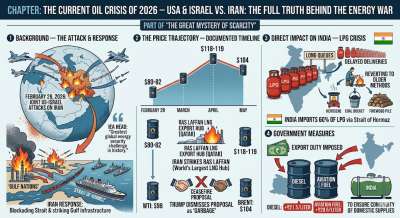
As soon as the war began, Brent crude surged by 10–13%, reaching $80–82 per barrel.
When Iran, in retaliation for the Israeli attacks, struck Qatar’s Ras Laffan energy facility—the world’s largest LNG export hub—prices surged even higher.
Brent crude climbed to $118–119 per barrel—its highest level since June 2022.
Talks of a ceasefire emerged—but Trump dismissed Iran’s proposal as “garbage.” WTI held steady at $98, while Brent remained at $104.
Direct Impact on India — What Happened?
In India, LPG was the first commodity to be affected. India imports 60% of its LPG, with the majority of it arriving via the Strait of Hormuz. Long queues and delayed deliveries became commonplace. People began reverting to kerosene, coal, and firewood.
The government imposed an export duty of ₹21.5 per liter on diesel and ₹29.5 per liter on aviation fuel to ensure the continuity of domestic supplies.
India increased its purchases of Russian crude—a prudent decision.
The Real Question — Who Benefits from This War?
What Did the US Gain?
Trump stated, “If prices rise, let them rise,” reasoning that the United States is an energy exporter. On April 24, US crude and petroleum exports hit a record high of 12.9 million barrels per day.
Simply put:
When the flow of oil from the Middle East was disrupted, demand for American oil surged. Prices rose. US oil companies raked in record profits.
The Game of Speculation
Citi analysts noted that crude markets were cushioned by high inventory levels and releases from strategic petroleum reserves. In other words, the actual physical shortage was not that severe—yet prices surged due to fear.
This is the very secret of scarcity that we highlighted earlier in this article.
Fear = Price Rise = Profit.
Qatar’s LNG—Another Blow
Qatar has declared *force majeure* on its gas exports. Qatar supplies 20% of the world’s LNG. It could take at least a month for production to return to normal levels.
Europe was already in a vulnerable position; following the harsh winter of 2025–26, gas storage levels stood at a mere 30%. The Dutch TTF gas benchmark doubled, soaring above €60/MWh.
What Does This Teach India?
The conflict involving Iran has further underscored the critical need for renewable energy. Solar and wind power do not rely on external supply—and, being decentralized, they offer greater autonomy.
This is our core message.
When the Strait of Hormuz is closed—
When Qatar comes under attack—
When sanctions are imposed on Russia—
The solar panels on your rooftop do not shut down.
The solar pump in your fields does not shut down.
Your solar cooker does not shut down.
Three Decisive Lessons—From the 2026 Crisis
Lesson 1: War and Oil Are Inseparable
Throughout history, self-interest regarding energy resources has lurked behind every major war. The events of 2026 fit this very pattern. A nation that is energy-independent need not be dragged into anyone else’s war.
Lesson 2: Speculation Is a Greater Force Than Actual Scarcity
The actual physical shortage was minimal. Yet, driven by fear, prices skyrocketed to $120 per barrel. This is precisely the “artificial scarcity” we have been discussing. Banks such as Goldman Sachs and JP Morgan trade in oil futures; for them, war represents an opportunity.
Lesson 3: India’s True Strength
In March 2026, India provided piped gas connections to 580,000 new households—gas sourced from domestic fields. This marks a step in the right direction.
However, even piped gas remains dependent on infrastructure. Solar energy, on the other hand, depends on nothing external.
*Atmanirbhar Bharat* (Self-Reliant India)—If Not Now, Then When?
The crisis of 2026 serves as a stark warning.
Today, LPG is expensive. Tomorrow, things will become even more expensive.
As long as we remain dependent on someone else’s energy—
we remain hostages to someone else’s wars.
The Sun’s energy is not for sale.
No sanctions can be imposed upon the Sun.
No one can blockade the Sun at the Strait of Hormuz.
“Adityasya namaskaram ye kurvanti dine dine.”
Those who offer their salutations to the Sun every day—
are liberated from all suffering.
—Our Vedas knew, thousands of years ago—
that the Sun is the only true source of energy.
॥ Urja Swaraj — Self-Reliant India ॥
Sources: Wikipedia — 2026 Iran War Fuel Crisis • CNBC Oil Price Timeline April 2026 • Al Jazeera Energy Markets Report March 2026 • IEA Strait of Hormuz Emergency Report • PIB India — Energy Security Statement March 2026
Public First | Truth. Freedom. Self-Respect.
Part Five — The True Alternative for Energy
Solar — The Truth That Was Hidden
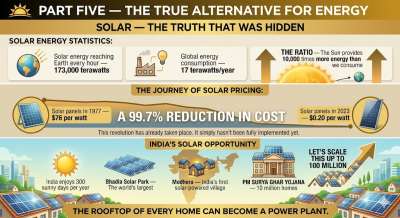
Solar Energy Statistics:
• Solar energy reaching Earth every hour — 173,000 terawatts
• Global energy consumption — 17 terawatts/year
• The Ratio — The Sun provides 10,000 times more energy than we consume
The Journey of Solar Pricing:
• Solar panels in 1977 — $76 per watt
• Solar panels in 2023 — $0.20 per watt
• A 99.7% reduction in cost
This revolution has already taken place. It simply hasn’t been fully implemented yet.
India’s Solar Opportunity
• India enjoys 300 sunny days per year
• Bhadla Solar Park in Rajasthan — The world’s largest
• Modhera in Gujarat — India’s first solar-powered village
• PM Surya Ghar Yojana — 10 million homes — Let’s scale this up to 100 million
The rooftop of every home can become a power plant.
Part Six — The Roadmap to Freedom from Scarcity
At the Personal Level — Starting Now
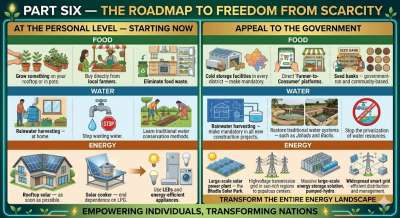
Food:
• Grow something on your rooftop or in pots.
• Buy directly from local farmers.
• Eliminate food waste.
Water:
• Rainwater harvesting — at home.
• Stop wasting water.
• Learn traditional water conservation methods.
Energy:
• Rooftop solar — as soon as possible.
• Solar cooker — end dependence on LPG.
• Use LEDs and energy-efficient appliances.
Appeal to the Government
Food:
• Cold storage facilities in every district — make mandatory.
• Direct ‘Farmer-to-Consumer’ platforms.
• Seed banks — government-run and community-based.
Water:
• Rainwater harvesting — make mandatory in all new construction projects.
• Restore traditional water systems — such as *Johads* and *Baolis*.
• Stop the privatization of water resources.
Energy:
• Implement the ‘PM Surya Ghar’ scheme on a war footing.
• Solar manufacturing — promote ‘Make in India’.
• Shift subsidies from fossil fuels to solar energy.
• Ensure EV charging stations are solar-powered.
Conclusion — The Ultimate Truth About Scarcity
The whole truth in three sentences:
Nature is abundant.
Scarcity is manufactured — as a means of control.
An awakened citizen can break this cycle.
And the deepest insight of all:
The Upanishads declared thousands of years ago:
“Purnamadah Purnamidam Purnat Purnamudachyate.”
That is Whole. This is Whole.
From the Whole, the Whole emerges; yet the Whole alone remains.
There is no scarcity in Nature.
Scarcity is man-made.
And what man has created — man can also dismantle.
This is true awakening.
This is *Atmanirbhar Bharat* (Self-Reliant India).
This is the People’s Great Reset.
॥ Truth Alone Triumphs ॥
Sources: FAO Global Food Report 2023 • Madhusree Mukerjee — Churchill’s Secret War • NCRB Farmer Suicide Data 2022 • IMF Fossil Fuel Subsidy Report 2023 • InsideClimate News — ExxonMobil Investigation 2015 • Naomi Klein — The Shock Doctrine 2007 • NITI Aayog Composite Water Management Index • Mullainathan & Shafir — Scarcity 2013 • IEA Solar Energy Report 2023 • PIB India — Energy Security Reports 2026
INDIAFIRST.ONLINE