INDIA FIRST . SATYA DARSHAN . ASHUTOSH .
HIGHLIGHTS FIRST:
The Legend of the Agni Linga: An Ideological Analysis Based on Jaya-Vijaya and the Mahabharata
Disclaimer
This article is an analytical essay based on alternative philosophical interpretations of Indian mythological texts—specifically the Mahabharata, the Puranas, and the Shaiva-Vaishnava traditions. The views presented herein are offered in the spirit of critical discourse and symbolic interpretation. The objective is not to disparage any deity, tradition, or faith, but rather to reflect upon the philosophical questions inherent in these mythological narratives.
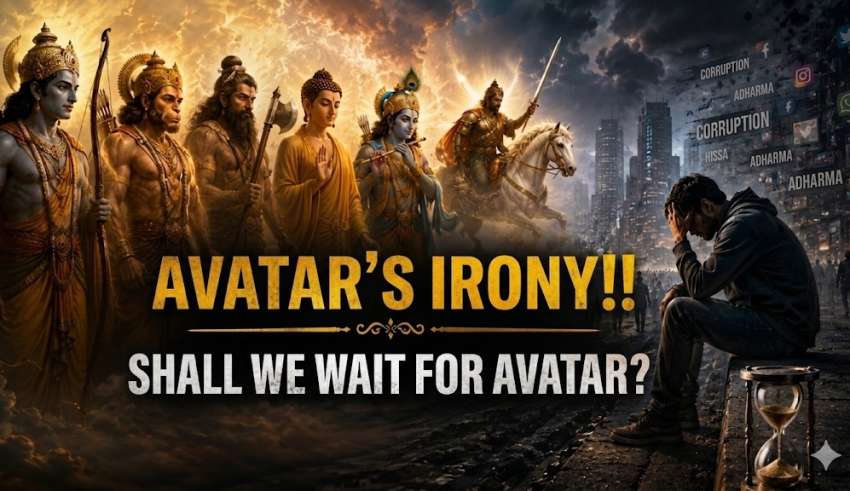
The Irony of Avatarism
Should We Await an Avatar?
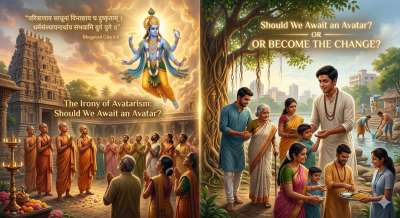
There is a very famous idea in the Indian religious tradition:
“Whenever there is a loss of religion, God will incarnate.”
Shri Krishna says in Bhagavad Gita:
“Paritrāṇāya sadhuṇām vinashāya cha duṣkṛtam.
Dharmasthapanaarthay Sambhavami Yuge Yuge.
i.e:
protection of saints
destruction of the wicked
establishment of religion
There are incarnations for.
But when we look at Mahabharata, Puranas and Shaiva scriptures together, many uncomfortable questions arise.
Ram’s descendants vs Krishna’s side
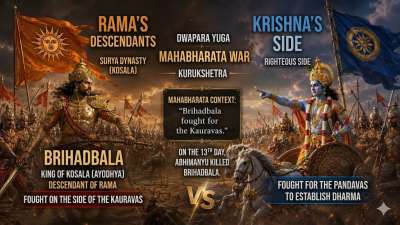
The Dwapara Yuga.
The Mahabharata War.
Kurukshetra.
The common perception is that:
Krishna = The side of *Dharma* (Righteousness)
The Kauravas = The side of *Adharma* (Unrighteousness)
However, within the annals of history and the Puranas, a curious fact emerges.
The King of Kosala — Brihadbala
According to the Mahabharata:
Brihadbala was the King of Kosala (Ayodhya).
He is considered a descendant of Rama within the Solar Dynasty (*Suryavamsa*).
And he fought on the side of the Kauravas.
Mahabharata Reference:
“Brihadbala fought for the Kauravas.”
On the 13th day of the war, Abhimanyu slew Brihadbala.
The Question:
Consider this.
Rama — An Avatar of Vishnu.
Krishna — An Avatar of Vishnu.
Then:
Why were the descendants of Rama
fighting on the opposing side to Krishna?
If both Avatars were representatives of the very same Ultimate Truth, why did their followers and descendants stand facing one another on the battlefield?
The Mahabharata itself acknowledged Rama
The “Ramopakhyana” appears in the *Vana Parva* of the *Mahabharata*.
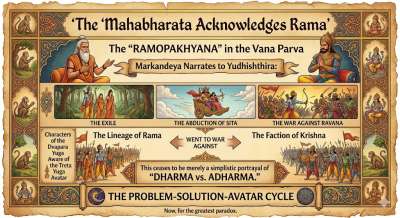
Markandeya narrates the story of Rama to Yudhishthira:
The Exile
The Abduction of Sita
The War against Ravana
In other words, characters of the *Dvapara Yuga* were aware of the Avatar of the *Treta Yuga*.
And yet:
The lineage of Rama
Went to war against the faction of Krishna.
This ceases to be merely a simplistic portrayal of “Dharma versus Adharma.”
The Problem–Solution–Avatar Cycle
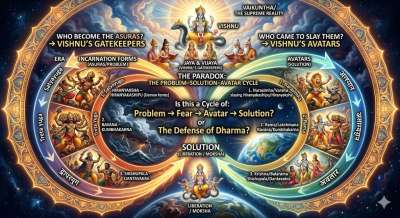
Now, for the greatest paradox.
According to the Puranas:
Jaya and Vijaya were the gatekeepers of Vishnu.
Due to a curse pronounced by the Four Kumaras, they were compelled to undergo three successive births:
Era | Incarnation Forms
Satyayuga = Hiranyaksha – Hiranyakashipu
Treta Yuga = Ravana – Kumbhakarna
Dvapara Yuga = Shishupala – Dantavakra
In other words:
Who became the Asuras (demons)?
→ Vishnu’s very own gatekeepers.
Then, who came to slay them?
→ Vishnu’s avatars.
Why is this question significant?
If the very same system is responsible for creating the problem,
and the very same system is also the one providing the solution—
then is this:
The defense of Dharma?
Or
A cycle of: Problem → Fear → Avatar → Solution?
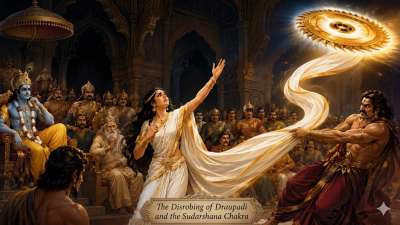
The Disrobing of Draupadi and the Sudarshana Chakra
Another question.
Shishupala insulted Krishna → The Sudarshan Chakra was unleashed.
But:
Draupadi was insulted in the assembly.
She was staked in a wager.
An attempt was made to disrobe her.
Why, then, was the Sudarshan Chakra not unleashed immediately?
Traditional explanations state:
It was a test of Dharma.
Justice was served when the time was right.
But a critical perspective asks:
Does even justice have to wait for the “right time” and the “Avatar”?
Was Dharma truly established after the Mahabharata?
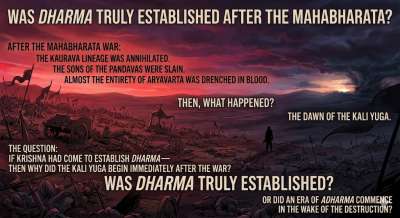
After the Mahabharata War:
The Kaurava lineage was annihilated.
The sons of the Pandavas were slain.
Almost the entirety of Aryavarta was drenched in blood.
Then, what happened?
The dawn of the Kali Yuga.
The Question:
If Krishna had come to establish *Dharma*—
Then why did the Kali Yuga begin immediately after the war?
Was *Dharma* truly established?
Or did an era of *Adharma* commence in the wake of the destruction?
The Legend of the Agni Linga — The Limits of Brahma and Vishnu
A Renowned Tale from the *Shiva Purana*:
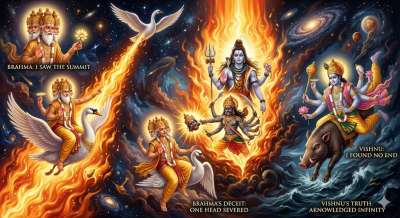
A dispute arose between Brahma and Vishnu:
“Who is superior?”
Just then, an infinite pillar of fire manifested.
Vishnu descended, assuming the form of a Boar.
Brahma ascended, assuming the form of a Swan.
Neither could find the end.
Then, what happened?
Vishnu admitted:
“I could not discover it.”
But Brahma lied:
“I have seen the summit.”
At that moment, Shiva manifested.
Kalabhairava appeared.
And one of Brahma’s heads was severed.
The Irony:
This very Brahma—who uttered the very first untruth—was later hailed as the one who bestowed the knowledge of the Vedas.
And that very Vishnu—who could not measure the Infinite, who could not comprehend the Absolute Truth—is the very one who, through his various avatars, has repeatedly proclaimed, “I alone am the Supreme!”
What does this tale signify?
Brahma = Creation
Vishnu = Preservation
Neither could comprehend the “Absolute Truth.”
In other words:
The Infinite Truth lay beyond even them.
Kalabhairava versus Waiting
Herein lies a profound symbolism.
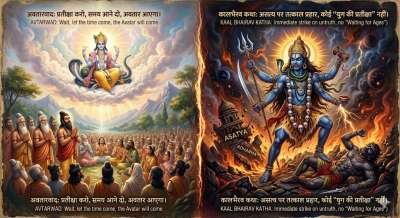
The doctrine of Avatarism asserts:
Wait.
Let the time come.
The Avatar will arrive.
But in the legend of Kalabhairava:
Falsehood is struck down instantly.
There is no “waiting for the age.”
Has the doctrine of Avatarism rendered society passive—content merely to wait?
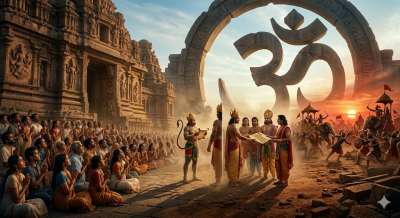
In the Ramayana:
Ravana abducted Sita;
Yet, Angad was sent as an envoy.
In the Mahabharata:
Draupadi was humiliated;
Yet, a proposal for “five villages” was still put forward.
One interpretation of these narratives is that:
Society became trapped in endless compromises and waiting before finally resorting to conflict.
Shiva vs. The Avatar Cycle
Shaiva philosophy posits:
Shiva = Infinite Consciousness
No birth
No death
No incarnation
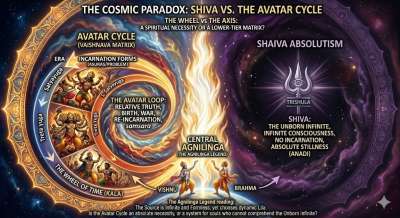
Whereas the narratives of the Avatars:
Birth
War
Destruction
Re-incarnation
operate within a cyclical loop.
The Ultimate Conclusion
When the *Mahabharata*, the *Puranas*, and the *Agnilinga* legend are read in conjunction, a profound question arises:
If:
The descendants of the Avatars fight amongst themselves
Vishnu’s own gatekeepers become the *Asuras* (demons)
The *Kali Yuga* commences in the aftermath of war
And even Brahma and Vishnu themselves fail to comprehend the Infinite Truth
Then is the “Absolute Truth” something that lies even beyond the Avatars?
It is for this very reason that the Shaiva tradition declares:
“Shiva alone is the Truth.
All else is merely the cycle of Time and *Maya* (illusion).”
Key References
Mahabharata — Vana Parva, Udyoga Parva, Bhishma Parva
Bhagavata Purana
Vishnu Purana
Shiva Purana — Lingodbhava Legend
Harivamsha Purana
INDIAFIRST.ONLINE