
INDIA FIRST . BHOPAL . KAILASH CHANDRA
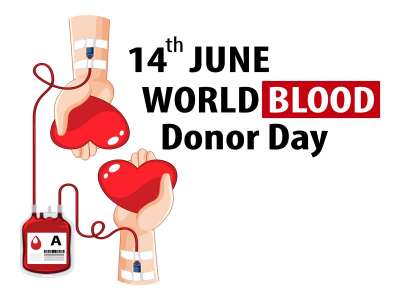
Every year on June 14, the world observes World Blood Donor Day. While it is commonly regarded as a day to honor blood donors and promote awareness about blood donation, its deeper significance extends far beyond a public health campaign. It is, in essence, a celebration of humanity, compassion, selfless service, and social responsibility.
We live in an age of extraordinary technological advancement, economic growth, and global connectivity. Humanity is planning missions to the Moon and Mars, artificial intelligence is transforming everyday life, and digital communication has connected people across continents. Yet, despite these achievements, modern society faces a growing crisis—the erosion of human sensitivity and empathy.
Across the world, divisions based on religion, caste, ethnicity, language, ideology, class, and political identity continue to deepen. Public discourse is increasingly dominated by polarization, hostility, and confrontation. Social media, while providing unprecedented opportunities for communication, often amplifies conflict and misunderstanding. In such an environment, the message of blood donation serves as a powerful reminder that our primary identity is not political, social, or ideological—it is human.
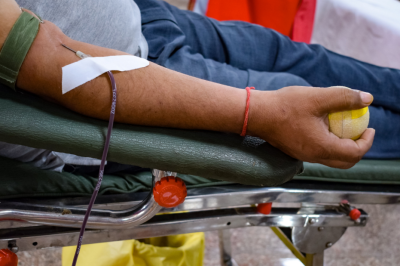
Blood has no religion. Blood has no caste. Blood has no political affiliation. When a patient in an emergency ward requires an urgent transfusion—whether a road accident victim, a mother facing childbirth complications, a child suffering from thalassemia, or a cancer patient undergoing treatment—the only bond that matters is the bond of humanity. This is why blood donation occupies such a unique place among acts of public service. It is one of the simplest and most direct forms of selfless giving. In just a few minutes, a healthy individual can contribute to saving the life of someone they may never meet. It is a donation in which the donor loses nothing of lasting value, yet society gains a precious life-saving resource.
Indian philosophical traditions have long emphasized the ideals of charity, service, and welfare of others. The spirit of seva (selfless service) and paropkar (benevolence) has been regarded as a moral duty and a path toward a higher social consciousness. Blood donation can be seen as a modern expression of these timeless values.
Unfortunately, many misconceptions about blood donation continue to exist. Some people believe that donating blood weakens the body permanently, while others fear adverse health consequences. Medical science, however, clearly demonstrates that voluntary blood donation by a healthy individual at recommended intervals is safe and beneficial. Greater awareness through schools, universities, community organizations, healthcare institutions, and public campaigns is therefore essential.

In a country as large and diverse as India, the demand for blood continues to rise. Road accidents, major surgeries, maternal healthcare needs, cancer treatments, and chronic conditions such as thalassemia require a steady and reliable blood supply. Yet many regions continue to face shortages, particularly rural, remote, and underserved areas where blood banking infrastructure remains inadequate.
This is where the combined efforts of government, civil society, and technology become crucial. Digital platforms, national donor registries, real-time blood availability systems, artificial intelligence-based demand forecasting, modern cold-chain logistics, and transparent blood management networks can significantly strengthen the healthcare system. However, technology alone cannot solve the problem. Its success ultimately depends upon human participation and social commitment.

Another challenge of our time is the growing distance between individuals and society. Consumerism, intense competition, and excessive self-interest have weakened the sense of community and collective responsibility. Acts of service are sometimes overshadowed by the pursuit of recognition, publicity, or political advantage. Blood donation offers a valuable lesson in contrast: true service expects nothing in return. A blood donor does not know who will receive the donated blood, yet chooses to give because human life itself is worthy of protection.
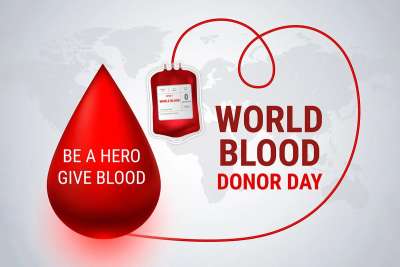
World Blood Donor Day also reminds us that the greatness of a civilization is not measured solely by its economic strength or technological achievements. It is measured by its willingness to care for the vulnerable, the sick, and those facing moments of crisis. A society that nurtures compassion, empathy, and mutual support possesses the resilience needed to overcome its greatest challenges.
The need today is not merely to organize more blood donation camps, but to build a culture of blood donation. Educational institutions must cultivate a spirit of service among young people. Community organizations, religious institutions, professional associations, and public authorities should work together to encourage regular voluntary blood donation. Through collective effort, India can move closer to becoming a nation free from preventable blood shortages.

The true message of World Blood Donor Day is that humanity remains alive—and keeping it alive is our shared responsibility. Every blood donor offers more than blood; they offer hope, confidence, and a reminder that compassion still exists in the world.
At a time when societies across the globe are experiencing ideological, social, and political divisions, blood donation teaches a simple yet profound truth: human blood is the same, human suffering is universal, and every human life is equally valuable.

On this World Blood Donor Day, let us pledge not only to donate blood whenever possible, but also to renew our commitment to compassion, service, empathy, and social responsibility. That is the enduring relevance and the most meaningful message of this important day.
“When we donate blood, we do not merely save a life; we reaffirm our faith in humanity itself.”
By Kailash Chandra
INDIAFIRST.ONLINE