
INDIA FIRST . SATYA DARSHAN . ASHUTOSH
HIGHLIGHTS FIRST:
The Cascade Effect:
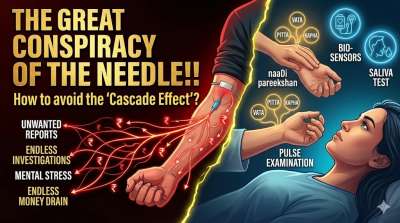
How a minor, non-essential blood test can plunge you into a quagmire of unwanted reports, endless investigations, and mental distress—a trap from which escape becomes virtually impossible.
The Hidden Physical and Psychological Harms of the Needle:
Beyond mere pain or bruising, there lies a documented risk of permanent anxiety in children and the danger of developing anemia due to repetitive testing.
The Syndicate’s ‘Loophole’:
The nexus between doctors and diagnostic centers, where ‘normal’ reference ranges are being manipulated in such a way that every healthy individual begins to perceive themselves as ill.
Your Statutory Rights:
How to—fearlessly, legally, and logically—refuse a test when a doctor attempts to prescribe it coercively? What are the safe and viable alternatives?
Legal and Philosophical Disclaimer

Disclaimer: This article is based on a comparative analysis of research papers published in the *New England Journal of Medicine* (NEJM), established medical principles, and patients’ rights as enshrined under Indian law (the Clinical Establishments Act). This article does not advocate for withholding emergency medical care or life-saving treatment. Its sole objective is to alert and raise awareness among citizens regarding the issue of “over-testing”—excessive diagnostic testing—driven by commercial interests within the medical field.
Part 1: The Documented Harms of Blood Draws (The Physical & Mental Cost)

We all regard this as a very routine and safe procedure. The doctor writes four tests on a prescription slip; we visit a pathology lab; a tourniquet is tied around the arm; the needle goes in, and the blood flows out. However, the history of modern medical science documents numerous serious physical and psychological risks associated with drawing blood via a needle (phlebotomy)—risks that are often kept hidden from the general public.

1. Fear of Needles and Psychological Trauma (Trypanophobia & Anxiety):
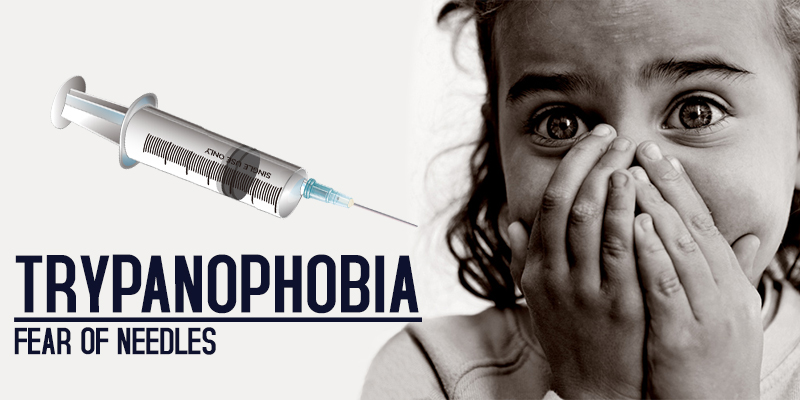
The fear of needles is not limited solely to children; it also induces severe psychological distress (anxiety) in adults. In the case of children, excessive exposure to needles during childhood creates a lasting fear and trauma regarding the medical system within their subconscious minds, leading them to avoid even necessary medical treatments in the future.
2. Bruising and Hematoma:
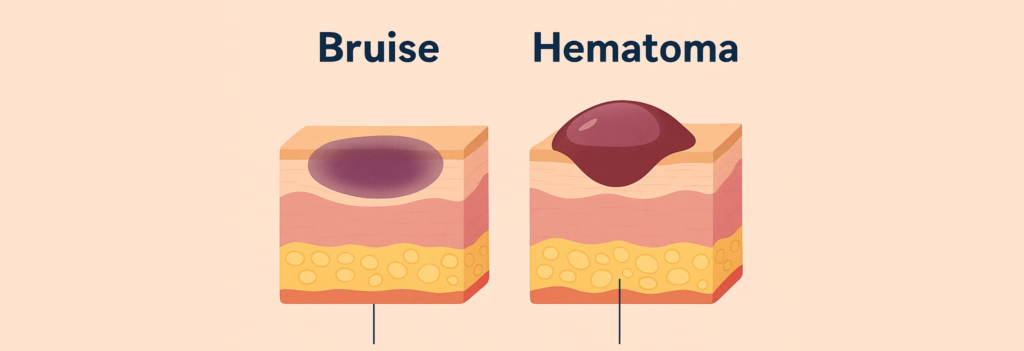
When a needle punctures a vein, blood sometimes leaks out of the vein and accumulates in the surrounding tissues. This causes the skin to turn blue or black (bruising), which may be accompanied by severe pain and swelling. If the person administering the injection is not skilled, the vein could sustain permanent damage.
3. Vasovagal Syncope (Fainting):
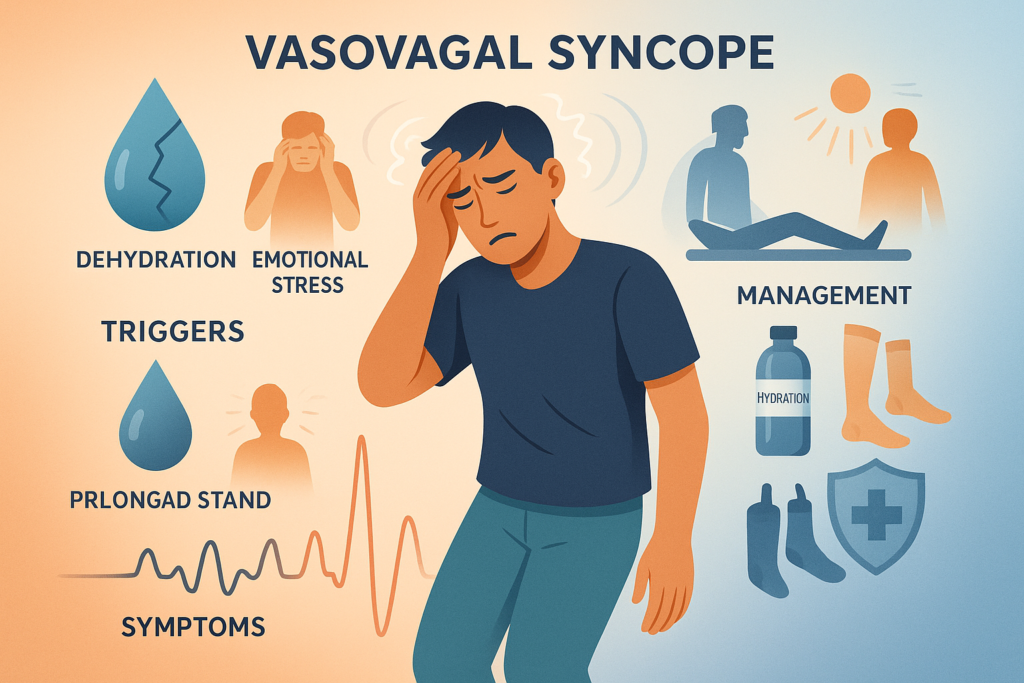
This is a very common and well-documented neurological response. The moment a needle pricks the skin, the body’s parasympathetic nervous system suddenly activates, causing a rapid drop in heart rate and blood pressure. This leads to a lack of oxygen in the brain, causing the patient to suddenly faint and collapse. Due to the fall, there is always a risk of sustaining severe head or bone injuries.
4. Risk of Infection:
If the needle is not completely sterile, or if the skin at the injection site has not been properly cleaned, bacteria can enter directly into the bloodstream. This can lead to life-threatening conditions such as ‘thrombophlebitis’ (inflammation and infection of a vein) or sepsis.
5. Risk of Anemia from Repeated Testing (Hospital-Acquired Anemia):
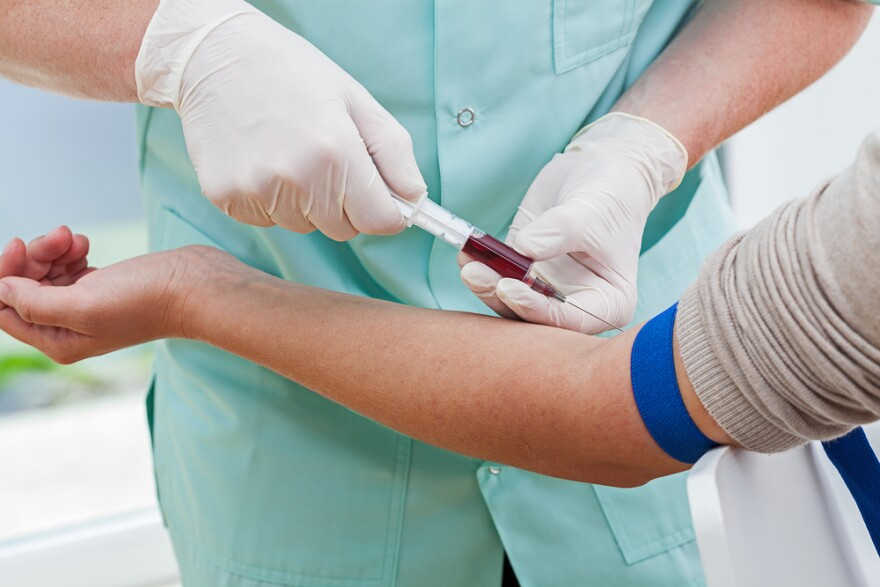
Patients admitted to hospitals have multiple vials of blood drawn from their bodies daily under the guise of routine checkups. According to reports in *Critical Care Medicine*, this process of repeated blood draws causes patients to develop ‘anemia’ (blood deficiency) while still within the hospital, necessitating external blood transfusions to replenish the deficit. This is an artificially induced condition.
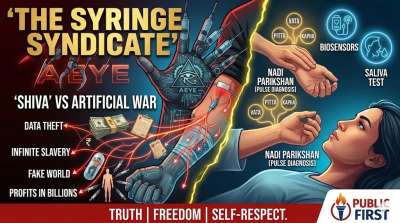
Part 2: The Cascade Effect—The Greatest Illusion of Medical Technology
Now, let us turn to that massive ‘game’—one that attacks your wallet and your mind far more than it does your health.

In 2011, a study was published in the world’s most prestigious medical journal, the *New England Journal of Medicine* (NEJM), titled “Cascade Effects of Medical Technology.”
What exactly is the ‘Cascade Effect’? Understand this very carefully. It is a trap—one into which, once you step, you find yourself sinking deeper and deeper:
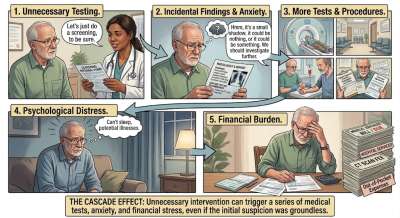
1. Incidental Findings:
Let’s assume you have no health issues whatsoever; you are perfectly healthy. A doctor prescribes a routine ‘full-body checkup.’ The human body is not a machine; its physiological values fluctuate on a daily basis. Consequently, the report from that test reveals a single parameter—such as a liver enzyme level or a specific cholesterol marker—that appears slightly elevated or depressed. In medical science, this is termed an ‘incidental finding’—meaning it is something that was causing you no harm, yet surfaced during the diagnostic testing.
2. The Business of Fear and the Endless Loop:
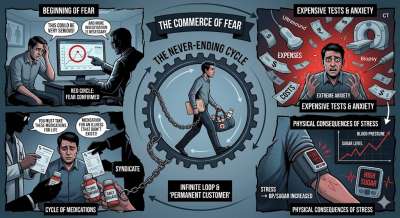
The moment that specific point falls within the red circle, the doctor alarms you. Now, to confirm that single point, the doctor prescribes three additional expensive tests (such as an ultrasound, CT scan, or biopsy).
As a result of these new tests, your anxiety reaches its peak. Due to this stress, your blood pressure and sugar levels rise on their own.
Ultimately, the syndicate starts you on medication for an ailment you never even had! You become their permanent customer—for life.
Part 3: How massive is this ‘scam,’ and what is the extent of the doctors’ pressure?

This is a multi-billion dollar diagnostic syndicate operating across the globe. Today, the revenue model of hospitals relies more heavily on diagnostics (medical tests) than on actual treatment.
Referral Incentives (Cut-Practice):

It is a bitter truth that, in many places, doctors receive hefty commissions—or a ‘cut’—from pathology labs in exchange for prescribing diagnostic tests. Consequently, even when you visit a doctor for something as minor as a cold or a cough, they hand you a long list of tests, such as CBC, LFT, and KFT.
The Game of Normal Ranges:
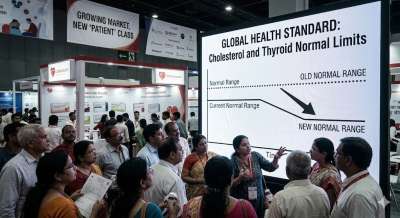
Over the past few decades, the ‘normal range’ for several conditions (such as high cholesterol, thyroid issues, and pre-diabetes) has been deliberately lowered by global health organizations. Blood sugar or cholesterol levels that were previously considered normal have now been reclassified as a ‘disease.’ Why? So that millions of healthy people turn into ‘patients’ overnight, thereby ensuring that the turnover of pharmaceutical companies continues to rise.
Part 4: How to Decline a Test When Prescribed by a Doctor? (Your Legal & Logical Rights)
Most citizens in India are unaware that they possess the legal right to question any prescription issued by a doctor. If a doctor is pressuring you or prescribing tests without a valid reason, you can defend yourself in the following ways:
1. Ask Logical Questions (The Informed Consent Rule):
Under the Medical Council of India (MCI) and the Clinical Establishments Act, patients have the right to ‘Informed Consent.’ When a doctor prescribes tests, ask these three questions calmly and without hesitation:

1. “Doctor, what is the direct connection between these symptoms of mine and this specific test?”
2. “If I choose not to undergo this test, how will it impact the course of my treatment?”
3. “Is it not possible for you to initiate preliminary treatment without the report from this test?”
If the test is indeed unnecessary, the doctor will realize that the person sitting before him is well-informed and will back down.
2. The Right to ‘Refuse Treatment/Tests’:
Legally, no hospital or doctor can compel you to undergo any specific test. You may provide a written statement declaring: “I voluntarily choose not to undergo this test at this time.” Based on this, a doctor cannot refuse to treat you (unless it involves a critical emergency or a medico-legal case).
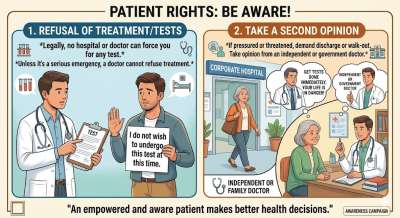
3. Seek a Second Opinion:
If a large corporate hospital attempts to alarm you by claiming, “Get tested immediately, or your life is at risk,” demand an immediate discharge or simply walk out. Seek an opinion from an independent, trustworthy family doctor or a physician at a government hospital.
Part 5: What is the Safe and Scientific Alternative?
Is it possible to understand the body’s condition without drawing blood using a needle? Both modern science and our ancient system of Ayurveda offer excellent alternatives:
1. Non-Invasive Diagnostics (Non-Invasive Technologies):
Bio-sensors and Wearables (Wearable Sensors):

Technologies have now emerged that can track sugar levels and other parameters in real-time—directly through contact with the skin (without the need for a needle prick)—by analyzing your sweat or interstitial fluid.
Saliva and Urine Tests (Saliva & Urine Analysis):
Levels of various hormones, vitamins, and toxins can be assessed with greater accuracy—and without the use of needles—simply by analyzing saliva or urine.
2. Ancient Indian Alternatives: Nadi Vigyan (Pulse Diagnosis):

Before the advent of modern pathology laboratories, the traditional healers of our country could identify precisely which organ of the body was developing an imbalance simply by placing three fingers upon the pulse at your wrist—interpreting the specific pulsations associated with *Vata*, *Pitta*, and *Kapha*. This practice represents the physical manifestation of the concepts of *Spanda* (Vibration) and *Vimarsha* (Reflection) as expounded in the *Vigyan Bhairav Tantra*. *Nadi Vigyan*—the science of pulse diagnosis—is capable of detecting an impending illness within your body months before it physically manifests, relying solely on the analysis of its ‘vibrational frequency.’

Conclusion:
Recognize your consciousness and body.

Only your own awareness can break through the labyrinth of this ‘cascade effect.’ This body of yours (the Agniling) is not a laboratory test tube, to be pricked with a needle by just anyone, at any time, merely to extract data or instill fear. The next time you are confronted with a long list of medical tests, instead of succumbing to fear, become vigilant. Ask questions, recognize your rights, and firmly refuse to become a pawn in this syndicate’s fear-mongering trade.
— India First | Truth. Freedom. Self-Respect.
Core Documented References:
1. New England Journal of Medicine (NEJM): The Cascade Effects of Medical Technology (2011) | Richard A. Deyo, M.D., M.P.H.
2. Critical Care Medicine Journal: Hospital-Acquired Anemia: Prevalence, Outcomes, and Strategy for Prevention (Phlebotomy-induced blood loss studies).
3. Clinical Establishments (Registration and Regulation) Act, India: Patients’ Rights and Charter Guidelines.
4. Charaka Samhita (Sutrasthana): The Fundamental and Scientific Relevance of Pulse Examination and the Tridosha Theory.